Why You Should Take A Journey Through West Africa – And What Awaits You
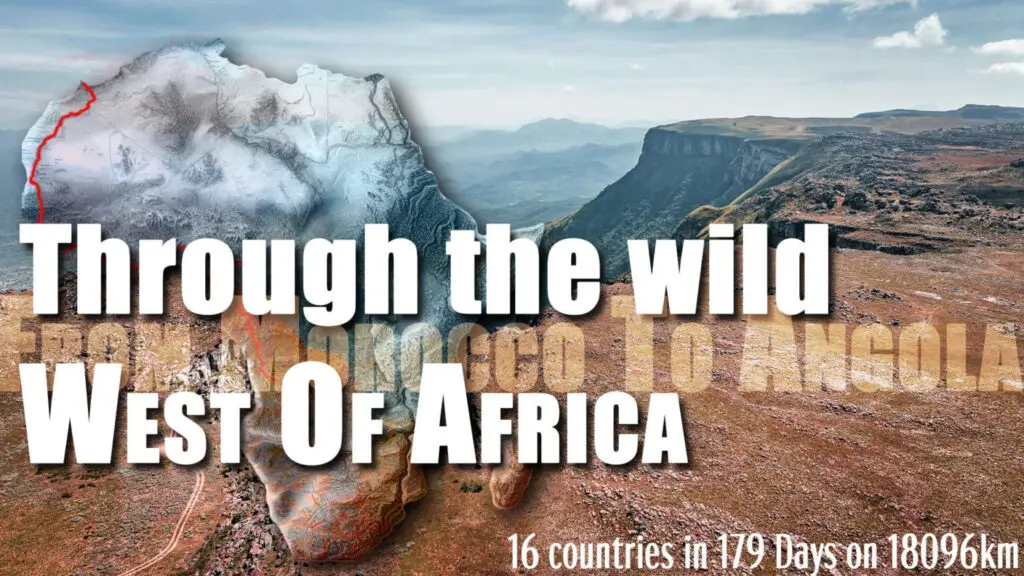
The decision to drive our 20 year “old” van along the West African coast to Angola is not a simple one. This is not an adventure you select from a catalog. Rather, it is a journey toward self-discovery, toward others and toward a continent that many know only from the media but few truly understand. It’s a yearning to experience authentic Africa – far removed from idealized notions and stereotypes.
Why undertake this journey?
What motivates someone to embark on such a trip? The answer lies not just in the desire for adventure, but also in the thirst for real experiences. West Africa is not a region of “epic landscapes” found on postcards. It is defined by its people, its culture, its resilience, its capacity for improvisation – and, above all, the reality that holds up a mirror to you.
This is not a challenge you take on simply to have a good time. Those who set out on this journey are in search of something real… at least we were. Mental fortitude, pragmatism and a profound willingness to embrace the unforeseen are essential. Every day on the road is an adventure that tests you and demands much of you.
As John F. Kennedy once said: “We don’t do it, because it’s easy, we’re doing it, because it’s hard“… or at least seems to be.
We didn’t take this journey because it was simple – we wanted to find out what truly awaited us. We wanted to confront the clichés, challenge urban legends (wherever they exist) and create awareness without sugarcoating anything. We aimed to remove fear where it’s unfounded – and face our own fears and preconceptions where it’s not.
For us – on the other side – the journey itself was never the goal, as we had long understood that West Africa is not a continent of pure beauty as we expect it. Our main destination was southern and eastern Africa, starting in Namibia. We simply aimed to avoid the rainy season in West Africa and pass through Nigeria as quickly as possible, since the rainy season here can last up to nine months.
Our plan worked perfectly. The October start was ideal, allowing us to travel through the various countries without undue haste. We saw, experienced, learned and felt a great deal. However, as time went on, we began to realize just how exhausting it all was. The need for recovery periods became more frequent and they needed to last longer.
Six months, then, turned out to be the perfect amount of time. It gave us enough space to take in the essence of the region – its people, culture and challenges – without burning out. We could dive deep into the reality of the journey while still maintaining a balance between exploration and the need to recharge. West Africa, with all its complexities, demands this balance, as it is not a place where one can simply race through. Time, patience and resilience become just as important as the experiences themselves.
Ultimately, the six months we spent in West Africa allowed us to engage deeply with the region and by the end, we understood the continent in a way that can’t be captured in photos or postcards. What we gained wasn’t just knowledge, but a profound transformation in how we view the world – and a recognition of our own limits, strength, and capacity to grow.

The Vehicle: 4×4 Not Required and Overrated! – But Endurance: Most Important And Often Underestimated
Choosing a vehicle for such a journey is more than a practical decision – it is part of the adventure… and it’s part of your life! If it breaks down, you’re stuck… and that might happen somewhere in the middle of nowhere.
We traveled in a Mercedes Sprinter 311 CDI 4×4. At first glance, one might think that a 4×4 is absolutely necessary, but that’s not the case! A good vehicle doesn’t need complex technology or specialized equipment. What it needs is a bit of ground clearance, robustness and… simplicity!
“Keep it simple, keep it stock”
Whether you’re traveling with a truck, a van or a micro-camper: the ideal car does not exist!
Truck: Offers maximum autonomy and off-road capability, ideal for extreme terrain and long isolation – but it’s expensive, bulky and always attracts unwanted attention due to its size and appearance.
Van: Strikes the best balance between comfort, mobility and discretion – spacious enough to live in, agile enough for narrow roads and border crossings and inconspicuous enough to park in urban or rural settings without standing out.
Mini-camper: Affordable, highly maneuverable and low-profile – perfect for budget-conscious travelers – but comes with serious compromises in comfort, storage and long-term livability, especially in remote areas.
For us personally – and especially on this tour – the van was the ideal solution: plenty of storage, not too big and not too small and – crucially – it provided the ability to retreat and lock ourselves in when needed. As the journey progressed, we came to realize just how essential that last point truly was.
As we drove a big part of this journey together with our friends Abenteuer-Campervan in a Sprinter 2×4, we were astonished, how capable this car was, apart from the fact that you don’t just “casually drive in” somewhere in this part of Africa, you often end up in compounds or deep jungle with no option to turn around.
Bring everything you might need and can’t easily find on the road – belts, hoses, sensors, diesel filters, seals, tools – because once you’re out there, you’re on your own.
Don’t count on garages: most repairs are quick fixes meant to get you 500 km down the road, if that. If you can’t fix it yourself, you’ll pay. Then you’ll wait. And you’ll hope.
Ordering spare parts? It’s possible – but slow, costly and nerve-wracking. Africa has some of the highest import duties worldwide. A €100 part can quickly turn into €300–500 with shipping, customs and bribes.
Your best bet: know how to fix it yourself – and carry what you need to do it.
The Roads and Diesel: The Invisible Challenges
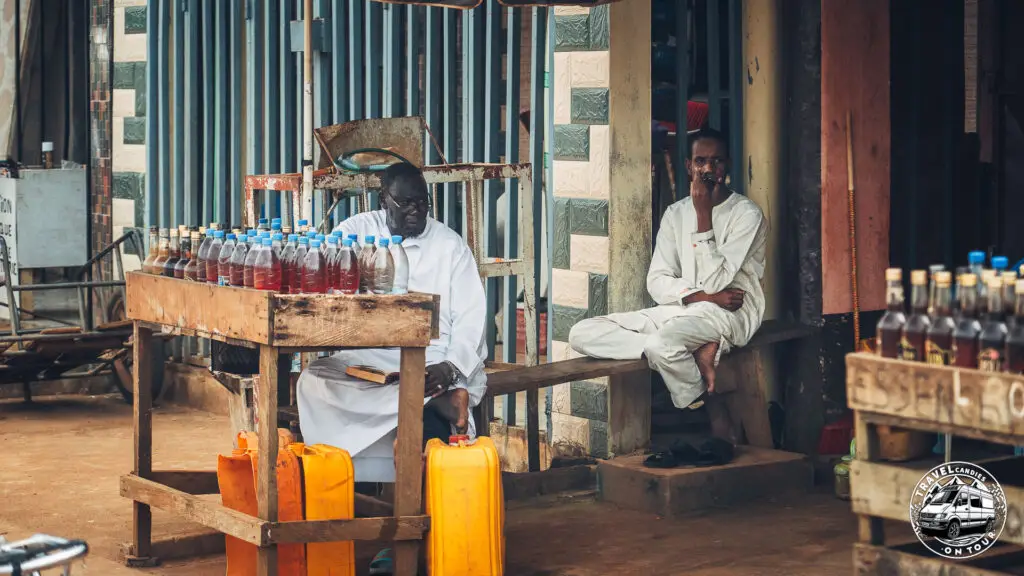
The quality of the roads varies greatly – from well-paved roads in Morocco or Kongo to nearly impassable tracks in Guinee or Nigeria. A vehicle with less frills handles these conditions much better.
A crucial note: Every vehicle will suffer. Dust, extreme heat, potholes and dryness take their toll on every vehicle – from the bodywork, the transmisson, the suspension to the engine.
Road conditions are a recurring theme throughout this journey. Asphalt often ends in the middle of nowhere and what follows are corrugated dirt roads, potholes and impassable stretches. Even then the best 4×4 has its limits.
Diesel in this part of Africa is said to be of poor quality – often containing over 2000 ppm of sulfur, adulterated, diluted with water or simply contaminated with dirt and sludge. It makes no difference whether it comes from a bottle or a fuel station.
In our case, the diesel pre-filter never showed water or excessive dirt and we didn’t experience any loss of power, black smoke or misfiring. We were lucky.
However, since our vehicle has neither an EGR system nor a DPF, we can’t truly assess the fuel quality. If your engine has either component, it’s wise to remove them, deactivate them or have them reprogrammed.
Better safe than sorry – we’ve heard more than a few stories of engine damage from fellow travelers.
Hygiene and Health: Prevention Is Key
Health risks on this journey should not be underestimated. Malaria, gastrointestinal diseases and infections are widespread. But again, prevention is the key. We prepared ourselves with essential medications, vaccinations and a well-stocked first aid kit. The conditions require constant hygiene – from handwashing to careful water purification.
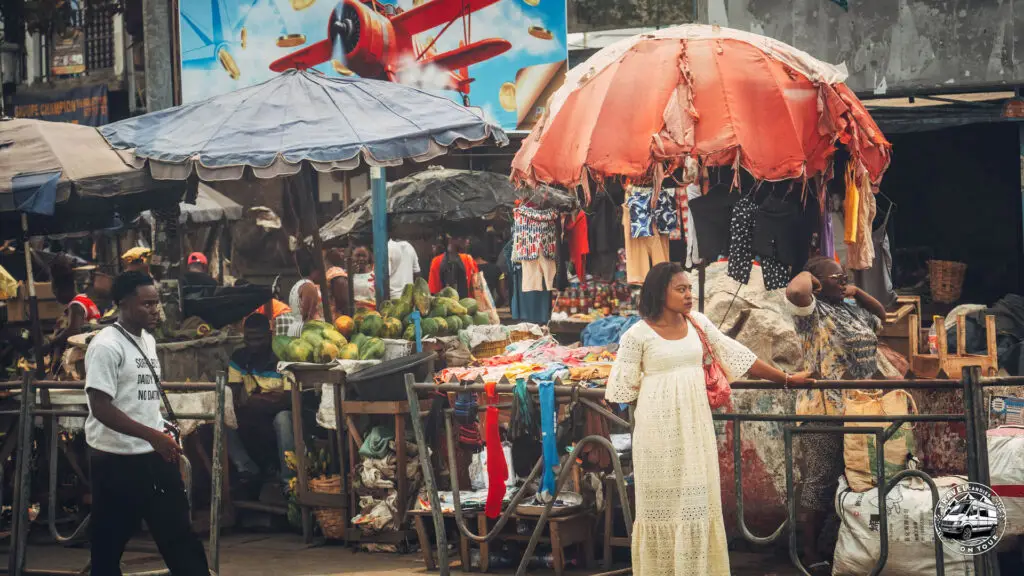
Water is generally abundant in West Africa – but not always in drinkable form. Filtration and chlorination should be considered to avoid health risks. As for food, cooking for yourself is often the best option. In cities, there’s fresh fruit and vegetables, but refrigeration chains aren’t always reliable – and you shouldn’t take that risk.
Roadside vegetables are often contaminated with fine dust, heavy metals or other toxins. In rural areas, pesticide levels can be extreme; in cities, fecal bacteria are more common due to irrigation practices. Many travelers wash their vegetables with bleach (no joke) or potassium permanganate – others avoid them entirely. We mostly did the latter.
Malaria is prevalent in many regions of West Africa, transmitted through the bites of infected mosquitoes and can lead to severe illness or even death if not treated promptly. Prevention involves taking antimalarial medications, using insect repellent, sleeping under treated mosquito nets and wearing long-sleeved clothing, especially during peak mosquito activity at night.
The mosquito population in this part of Africa is and was very high, though we never contracted malaria. We used Care Plus with 50% DEET as our primary protection.
Vaccinations: Yellow fever (mandatory), Hepatitis A/B, Typhoid, Meningitis, Rabies – strongly recommended in nearly every country in Western Africa.
Visa, Bureaucracy and Checkpoints: Patience And Kindness Are Essential
Obtaining visas is not easy – especially in the West African countries. Some countries require several weeks to process a visa (or you’ll need to pay a lot on extra “express fees”) and the requirements vary significantly. Many countries require an invitation letter, hotel reservations and bank statements. Anyone who thinks bureaucracy is only a European problem will be disabused here… Africa takes it just to a complete new level of bullshittery.
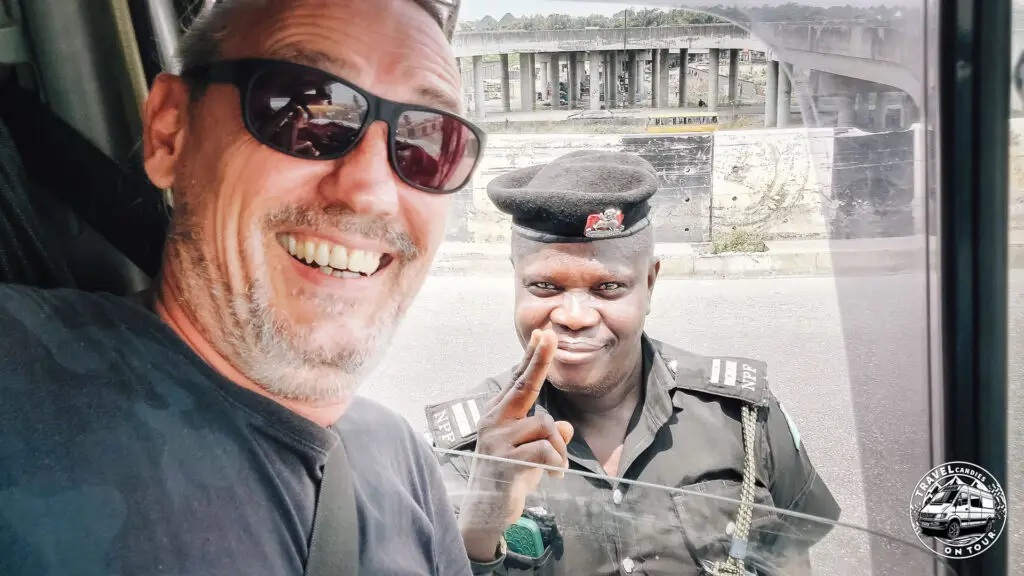
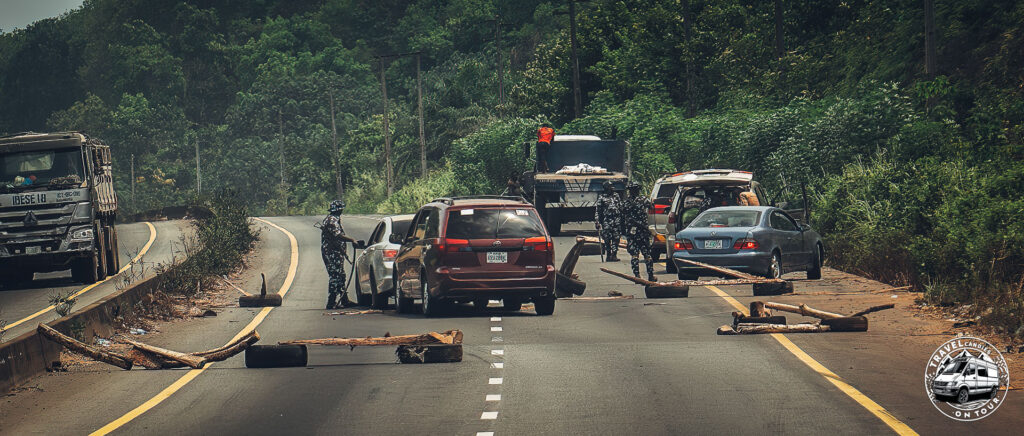
You’ll constantly deal with border formalities and corruption at the checkpoints. Crossing borders is rarely quick or straightforward – whether it’s through questioning, bribery or long waits. Corruption is present in every single country we passed through, up to Namibia. Sometimes it’s subtle, sometimes more aggressive – often starting with a simple request, then escalating to a demand. Many times, papers won’t be handed over without payment. Fees are often imposed that don’t exist or officials simply expect “gifts.” Being asked for nothing is the exception, not the rule. The absurdities of some situations will make you question the generic common sense.
Allow a lot for buffer time, be patient, always be friendly and never ever pay bribes. N.E.V.E.R!
Fun-Fact: On our route straight through Nigeria we passed 203 checkpoints. See the video here.

People In West Africa
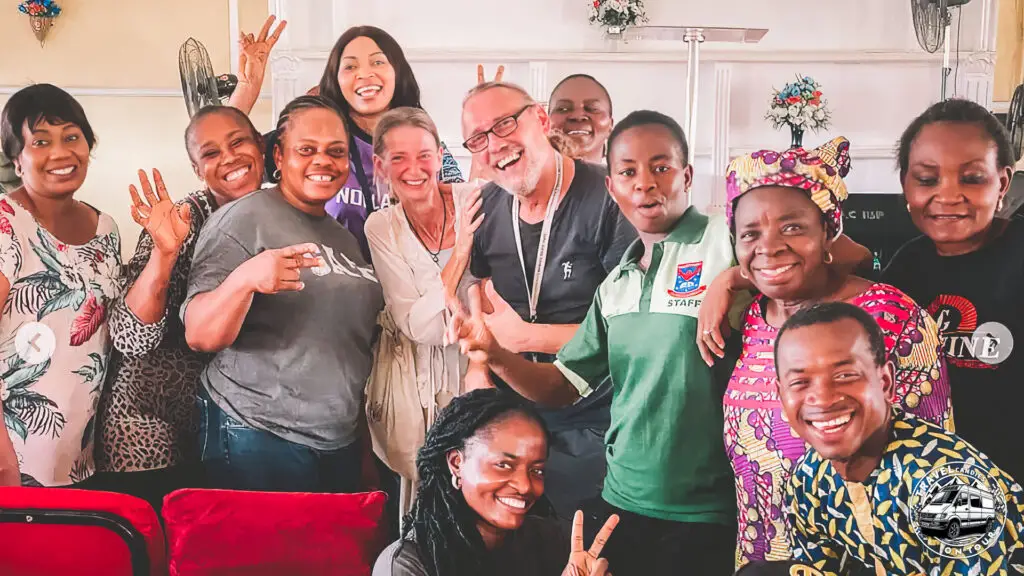
In general, the people we met were very kind, friendly, always waving and smiling. Deep conversations were rare, but Nigeria really surprised us in that regard. Ultimately, though, it often boiled down to begging: for food, drink, or money. People were surprisingly selective when it came to food and beverages, but when it came to money, they almost always wanted euros or dollars.
The widely spread, urbanized and often romanticized myth that even Black people are frequently begged from, just didn’t match our experience. We never once saw locals begging other locals. This gave the whole situation a rather unpleasant taste, especially when we really wanted to connect with the people. In the end, it led to us retreating more and more, avoiding contact as much as possible.
The behavior of many people we encountered on this journey can’t simply be explained by “poverty” – because, at least in much of West Africa, hunger or severe scarcity isn’t the dominant issue. Food and water are often abundant and nature provides generously. As one local put it: “Africa allows us to be lazy. We don’t have to do anything for all this – it’s a gift from God.”
What we experienced was less true need and more a deeply rooted expectation toward white travelers: We give, they take. It’s an unspoken, one-sided arrangement – often without gratitude or reciprocity. It’s not openly demanded, but almost universally expected. Those who don’t play along are quickly ignored or met with disapproval.
That makes genuine connection difficult. Over time, you stop feeling seen as a person and start feeling like a walking wallet – smiled at only as long as you’re handing something over. When you realize that, you begin to withdraw – not out of arrogance, but for your own peace of mind.
That’s the reality and it’s one you have to face head-on, no matter how uncomfortable the pure truth may be!

Pricing Structure – “The Price Of Paradise”
Aside from the already high visa costs – often several thousand euros for two people – it’s the daily expenses that make West Africa surprisingly expensive. Diesel may seem cheap, but since it’s almost always paid in cash, poor exchange rates and high ATM fees quickly add up. Food can also be a financial trap: a can of chili con carne for €15, a can of ravioli for €11 or 1 kg of tomatoes for €13 – not rare, but standard in this region. Imported goods are outrageously expensive in general. Spare parts are even worse – sometimes up to twenty times the European price, if you can find them at all.
Campsites (if available) often charge European prices for African standards and wild camping is increasingly complicated by “expected gifts” or direct demands. Even internet is a luxury: in some countries, a single gigabyte of mobile data can cost up to €15.
Conclusion:
Africa – contrary to popular belief – is expensive. Looking back, West Africa has been one of the most expensive legs of our entire journey.
But look forward to Namibia – suddenly, everything gets so much better😉
Safety On The Road: Reality Over Hysteria
Despite all the horror stories and warnings, we rarely felt truly unsafe during our journey through West Africa. Yes, we were stolen from multiple times and occasionally harassed or mistreated – but let’s be honest: that can happen anywhere in the world. What matters is staying alert, trusting your instincts, avoiding risky places at night and securing your valuables. Most encounters were peaceful and many people treated us with basic hospitality.
Fear shouldn’t stop anyone from visiting these countries – but naïveté can be just as dangerous.

Wild Camping: A Challenge, Not a Problem
Finding a good wild camping spot in West Africa isn’t always easy, but it’s far from impossible. Sometimes it takes longer, sometimes you get lucky right away – but one thing’s for sure: you’re rarely ever completely alone. As we like to say, “There’s always someone who suddenly screws themselves out of the ground – and you have no idea where they came from.” Whether deep in the bush or behind a remote village, curious visitors are almost guaranteed.
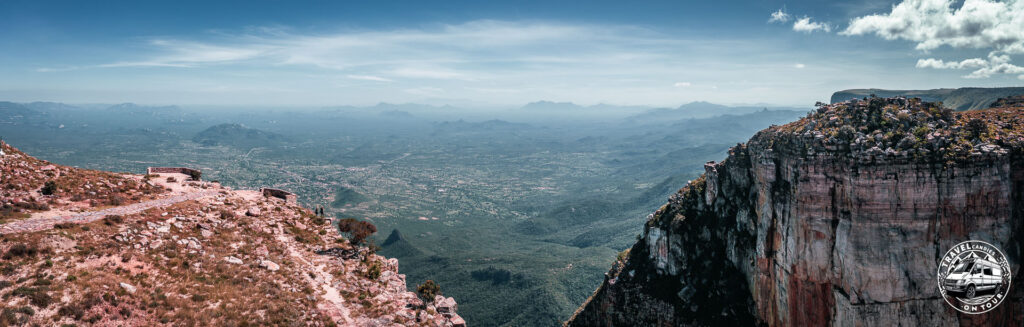
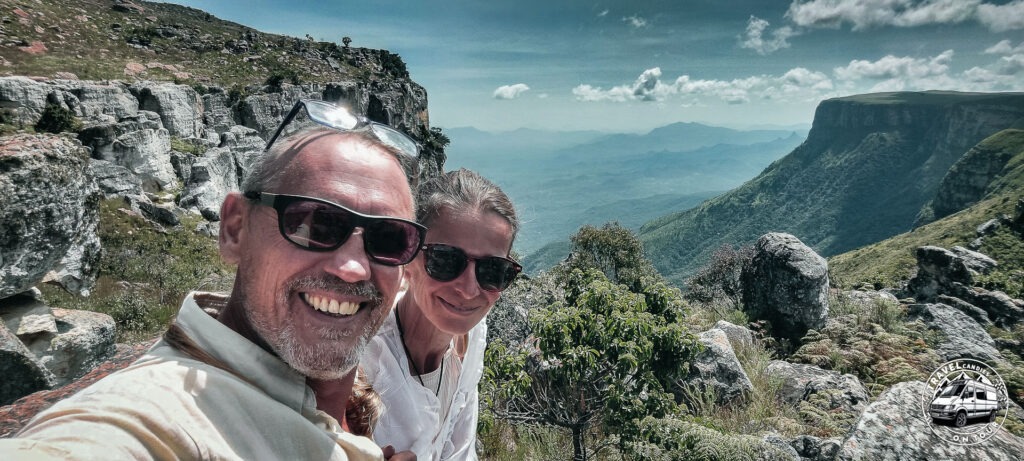
West Africa: A Land of Details and Encounters
What truly defines this journey is not the landscapes, but the encounters. West Africa is not a land of “epic natural wonders,” but a continent shaped primarily by its people and cultural diversity. In each country, in every city, in every village, you meet people who improvise, who live, who fight and who share. Here, it quickly becomes clear that life goes on, no matter how bad the roads or the weather.
The true value of this journey lies not in the “epic” views, but in the changes it brings. West Africa challenges you – as a traveler and as a human being. You’ll place less importance on luxury and develop more understanding of life and the challenges faced by its people. You’ll become quieter, clearer, stronger. You’ll learn what really matters.
Conclusion: Should You Do It? Yes, absolutely.
This journey will change you. It will challenge you, push you to your limits and there will be moments when you won’t know how to move forward. But you’ll also discover just how strong you truly are.
Would we do it again? No, definitely not.
Not because it was bad – but because it demands everything from you. It’s a journey that you should experience only once in your life. But this experience will stay with you for the rest of your life.
We’re truly glad we had the courage to take on this journey – and deeply grateful we were able to do it. Even though it was often exhausting and became increasingly demanding, we wouldn’t trade this part of our trip for anything. It was breathtaking, adventurous, grand and unforgettable – yet also grueling, punishing and at times deeply challenging. An absolutely spectacular experience we’re now thankful has come to an end.
Along the way, we met quite a few other travelers – and we also heard countless stories about people who didn’t make it all the way through. Many turned back early or ended their trip halfway, not because they lacked passion or preparation, but because the stress simply became too much. The constant uncertainty, the never-ending logistics, the daily “what’s next?” pressure and the mental load of always having to stay alert can wear you down faster than you’d ever expect.
For some, it was the bureaucracy that broke them: borders that took forever, documents that suddenly weren’t “right” anymore, or rules that seemed to change from one hour to the next. For others, it was the vehicle – small issues turning into big problems, parts that couldn’t be found, repairs that took days and the realization that in some places you don’t just fix a breakdown… you live inside it until it’s solved. And then there are the costs. Even if you try to travel on a budget, West Africa can surprise you with expenses that feel completely disproportionate – visas, checkpoints, “fees”, overpriced accommodation when camping isn’t an option and the constant need to adapt your plans on the fly.
What makes it even harder is that there are no real breaks. You don’t get to switch off. Even on “easy” days you’re thinking ahead: fuel, safety, road conditions, weather, where to sleep, how to avoid trouble, how to stay healthy. You’re always calculating, always negotiating, always making decisions – and that continuous pressure is exactly what pushes many people to quit. Not because they are weak, but because the journey is relentless.
And honestly? We understand every single one of them. There were moments when we questioned our own choices, when we felt drained, overstimulated and just tired of having to fight for every little thing. West Africa doesn’t hand you comfort. It doesn’t care about your plans. It forces you to let go of control – and that is both the hardest part and the greatest lesson.
Finishing this route gave us a quiet kind of pride. Not the loud “look what we did” kind – but the deep feeling of having endured something real. We came out of it changed: tougher, humbler and far more grateful for the simplest things. And while we’re happy it’s over, we’ll always carry it with us – as one of the most intense chapters of our lives.
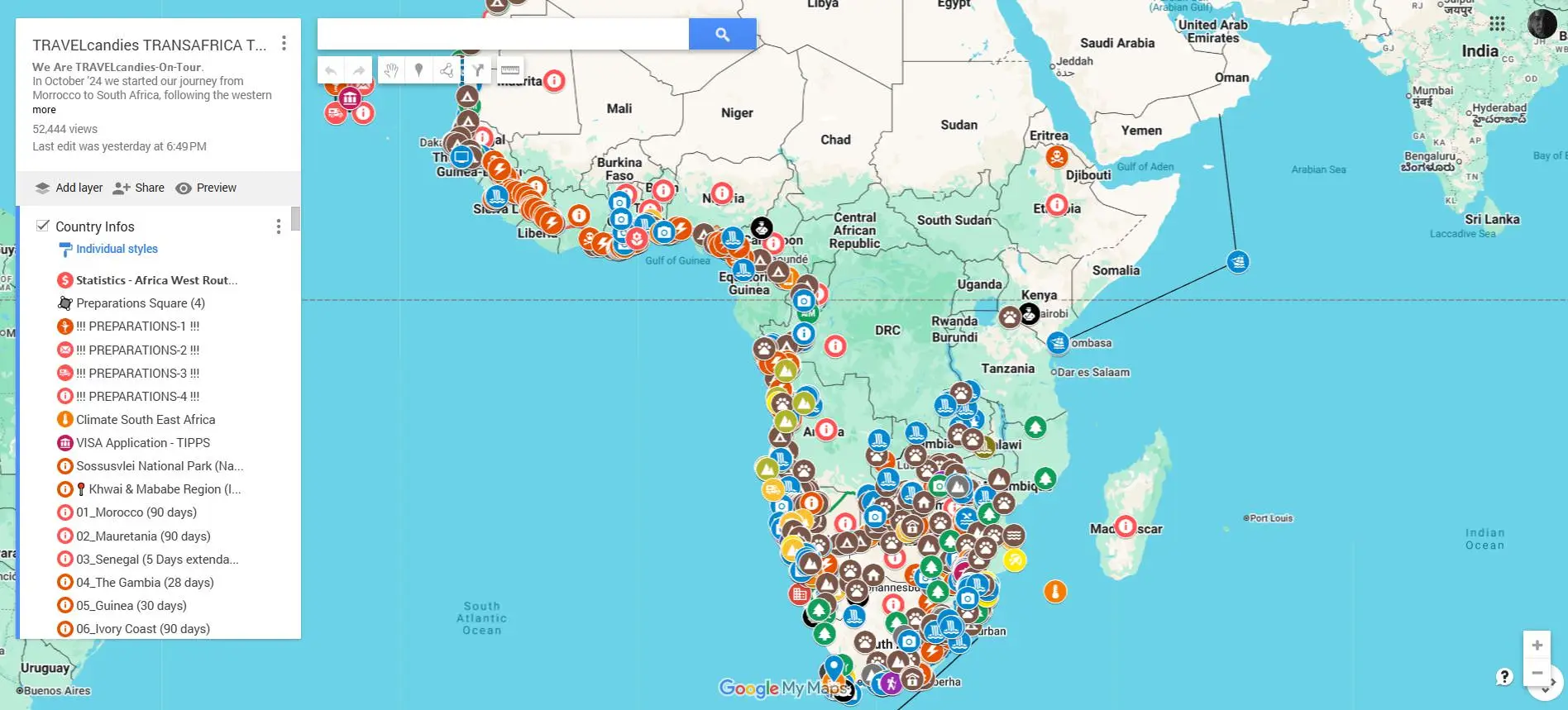
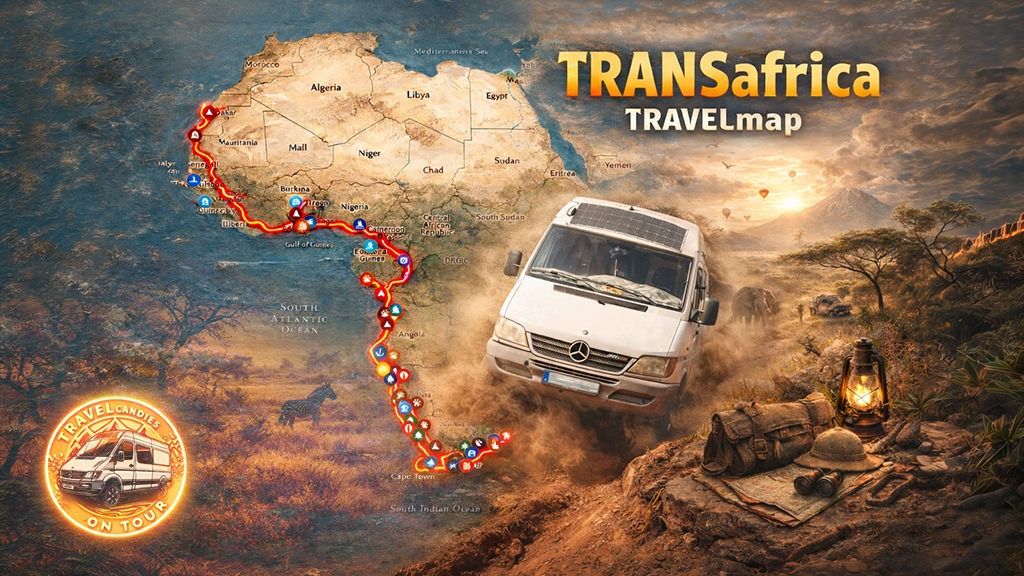
From Morocco to Kenya – overland, unsupported and as raw as it gets. This route reflects 2 years of dust, diesel, detours and discovery.
Each marker tells a story: some beautiful, some bitter, but all real.
It’s not the fastest way, but it’s ours.
And if you’re planning your own journey through West Africa:
Help yourself!
This map includes everything you might need for your own adventure
– A fully recorded track through each individual country
– Accurate GPS coordinates for campsites and wild spots
– Border crossings with detailed notes
– Visa and bureaucracy info by country
– Road conditions with pictures
– Fuel stops and diesel quality notes
– Safety tips and checkpoint locations
– Mechanics, markets and supply points
– Personal comments and warnings
– Dozens of pictures
– Links to our videos on youtube
It’s not just a map – it’s a lived route. Use it. Adapt it. Make it yours.
The map is still a work in progress and I’m working on it every day. In August/September we’ll most likely be in Kenya and by then the map editing should be completed.
Until that time, the map is completely free to access – but donations are very welcome😌
(details you’ll find inside the map).
Just send me an email or click on the map. Google will then ask me to approve access for you.
Read the blog about the TRANSafrica TRAVELmap for further informations and many more details.
And hey… visit our traveler buddy “Lubo”, who set up another pretty good resource for Africa travelers recently. Whether it’s about Visa, Border Crossings or even accomodations : you’ll find some very helpful infos here.
Enjoy!
Yours Totti from TRAVELcandies-On-Tour