How Do We Afford to Live Without a regular Paycheck?
What’s in here?
- We Evolved Our Mindset
- It All Started With A Bucket Of Water
- Saving Energy, Not Comfort
- A Revival Of Old Fashion
- Repair, Reuse, Repeat
- Cars: Where We Never Really Wanted To Save
- Looking For A Third Pillar
- Some Worked. Most Didn’t
- The Bryce Canyon: The Place That Led Us To Passive Income
- From Almost Nothing To Our First Investments
- Namibia 2019: The Trip That Changed Everything
- Turning Investment Returns Into Monthly Income
- Making The Tax System Work For Us
- The Final Piece: Calendars
- What To Take Away From All This?
- FAQ
We already had the right mindset – We just needed to evolve it
The question of how we can afford our life without a regular paycheck sounds simple. The answer is anything but. I mean, it’s simple indeed and of course no rocket science, but the explanation will take its time, because it was a progress over the years.
It is probably the question we get asked most often. And according to the questions people ask us and the search terms, that bring people to our website, there is one question that clearly burns under people’s fingernails:
“What do they actually do for a living?”
Fair enough.
Most people simply ask. Some hesitate, probably because asking about somebody else’s money can feel a little awkward. But we can usually tell, when the question is there. After all, we have been travelling for years, moving from country to country, carrying a frankly ridiculous amount of equipment and living a life, that doesn’t exactly look cheap from the outside.
Are we sponsored? Do we still earn a lot of money? Did we inherit something? Do our families support us? Are we dependent on donations, Youtube income?
No, no, no and no… none of all that.
Many travellers prefer to keep the financial side of their lives to themselves. Maybe that’s a German thing. We don’t. Sharing is caring and if our story can motivate somebody to rethink their own relationship with money, consumption and freedom, then why keep it secret?
At the end, we’re just answering a simple question: How’s that possible for us?
To understand, how we can live the way we do today, though, we have to go back several decades.
I was born in 1969 and didn’t grow up with much money. Fenny, born in 1972, had a completely different childhood. She grew up financially comfortable. But she is Swabian – and for those who aren’t familiar with Germany: Swabians have a legendary reputation for being “extremely careful” with money.
Let’s just say, that frugality is supposedly absorbed with their mother’s milk.
Our backgrounds were very different, but somehow we ended up with exactly the same basic principle:
The Main Key: We started to use our resources more wisely
That principle stayed with us as our professional lives took off. We had good jobs, earned good money and enjoyed a quite comfortable lifestyle. We had nice cars and lived in beautiful apartments with pretty much every modern convenience you could imagine.
And yes, we enjoyed it.. why not?… We worked hard for it and we didn’t want to just survive.
We wanted to live a good life. As everyone should be able to do – and everyone should be able to afford.
But we also knew, that none of it was guaranteed to last forever. Jobs can disappear, income can change and circumstances can turn around much faster, than you might expect. So we started asking ourselves a rather simple question:
How can we get more out of the money we already have?
Not by making our lives miserable, sitting in the dark to save electricity or wearing the same pair of trousers until they fall apart. Well… actually, the trousers part comes later😉.
We simply started looking at our resources differently. Why spend money on something, if we didn’t really care about it? Why throw something away, if it could still be used? And why waste perfectly good resources just because we may be able to afford to?
We weren’t trying to live like poor people, and saving money wasn’t the goal either. We just started asking ourselves whether the things we spent money on were actually worth it and whether we could make better use of what we already had.
And that mindset eventually found its way into almost every part of our lives.
It All Started with a Bucket of Water
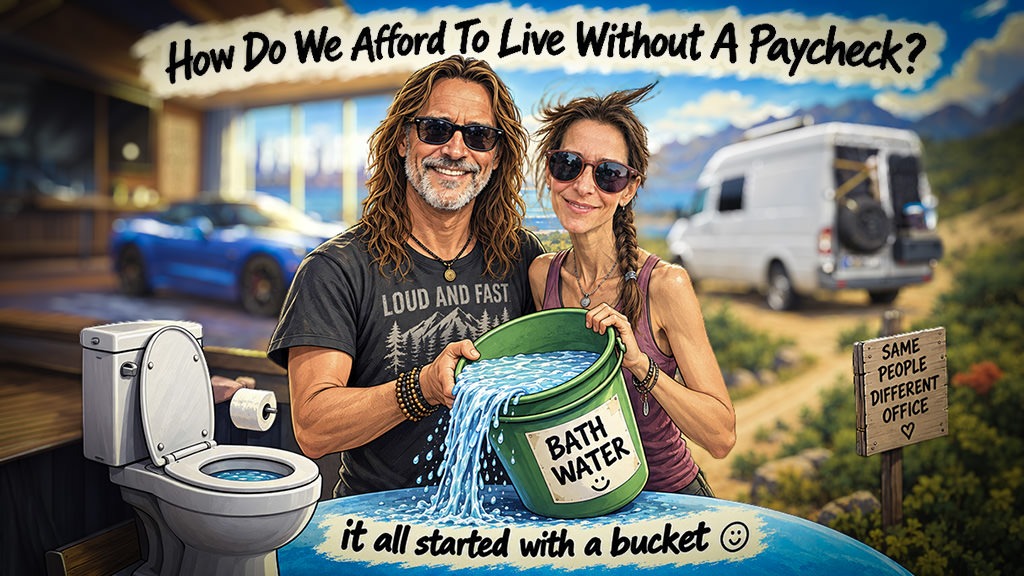
Our apartment was fully equipped with smart-home technology. Lights, music, blinds and pretty much everything else could be controlled by voice. Even the light switches were practically little computers. Not because I was particularly smart, but quite the opposite: I was too stupid to remember which button did what. Saying “Bathroom, lights on” was considerably easier than standing there trying to decode the bloody switch. And besides, we just liked that nerdy stuff.
One day, we had a friend who needed to use the bathroom. He didn’t know how to turn on the light, so I explained the sophisticated technology to him:
“Just say Bathroom, lights on.”
He did. The light came on. Technology worked. Humanity had advanced another tiny step.
A few minutes later, he came back. He had that slightly awkward grin people get when they have a question but aren’t quite sure whether they should ask it.
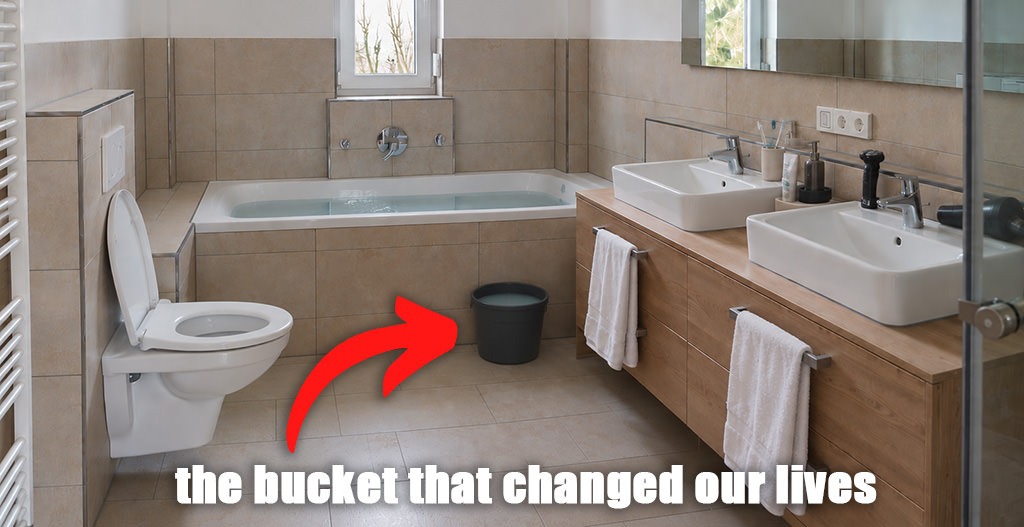
I looked at him: “You’re wondering about the bucket next to the toilet?“
“Well… yeah.”
“That’s for the bathwater… if you like, you can use it to flush the pee and poop down.”
His eyes got wider and he burst out laughing: “WHOTT?”
Fair enough. In an apartment with a smart home, two bathrooms and all the bells and whistles, a bucket of water next to the toilet does look slightly out of place.
The explanation was simple, but effective: we reused our bathwater to flush the toilet.
A bath used roughly 150-200 litres of water, so instead of sending all that perfectly usable water straight down the drain, we used it to flush the toilet. One flush can use around 5–8 litres of fresh drinking water. Why would we use drinking water to flush Kacka down the toilet if we already had 200 litres of perfectly good water sitting in the bathtub?
In Namibia, there is a saying: “If it’s yellow, let it mellow. If it’s brown, let it down.”
That made us think!
And I remember Afrikaners putting it even more bluntly, when talking about Europeans:’
“What problems can you possibly have? You even shit in drinking water.”
Crude? Absolutely. Wrong? Completely not.
So we did, what we tend to do, when we come up with an idea, that sounds slightly ridiculous: we did the math. After a year, we checked the actual numbers.
Our water costs had dropped to almost exactly half. We really hadn’t expected that. And this wasn’t some theoretical calculation. We had actually measured it – and there was more money left in our pockets.
And that was the funny thing about it. We simply didn’t see any contradiction between living comfortably and reusing bathwater to flush the toilet. To us, it was just common sense.
That little bucket turned out to be a pretty good symbol for the mindset that would eventually shape many of our financial decisions.
Yeah… it all started with this bucket🤷♀️
Saving Energy, Not Comfort
The bucket of water got us thinking about what else we could do differently. We had never been the kind of people who left lights on, simply because we were too lazy to switch them off. There was no point heating rooms nobody was using either.
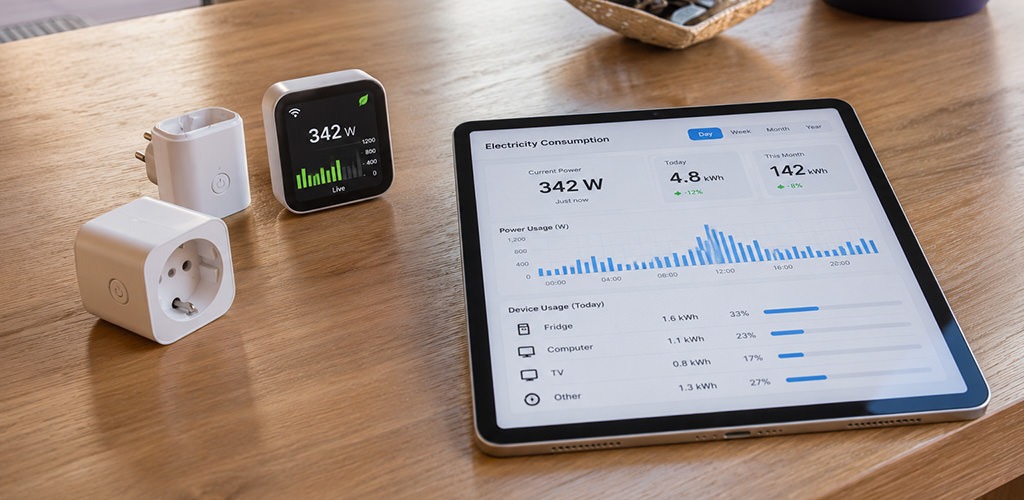
But we took it a step further. Whenever we replaced an electrical appliance, energy consumption became part of the decision. It wasn’t just about what the new appliance could do or how much better it was than the old one. How much electricity does it use? became an equally important question.
From the coffee machine to the Dolby Atmos system, we gradually made our home more energy-efficient without giving up comfort. And because almost everything was connected to our smart-home system, we could turn things on and – even more importantly – turn them off automatically or remotely when we weren’t at home.
That made a surprisingly big difference. We weren’t sitting in the dark or freezing just to save a few euros. We simply stopped wasting electricity when we didn’t need it. Pocket said “Thank You” again.
It was the same principle as the bucket:
we used what we needed, but didn’t waste what we didn’t.
A Revival of Old Fashion
Once we started questioning one thing, we began to notice how many things we bought simply because we were expected to.
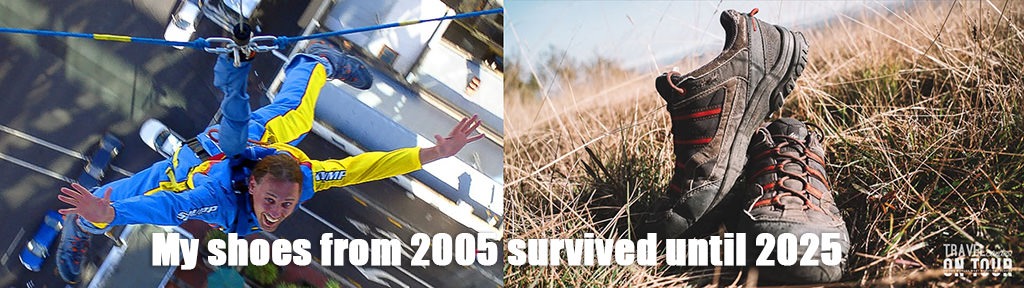
We opened a cupboard and found a pair of jeans that were 20 years old but still looked almost new. So why throw them away? Nobody knew how old they were or whether they had cost €1 on eBay or €100 in a jeans store. They were just jeans.
The same applied to technology. We didn’t need the latest smartphone the moment it hit the market. We were happy to wait until the prices had dropped and buy a phone that was still bloody good – it just wasn’t fashionable anymore. And second-hand? Our wallets love second-hand. Stereo systems, drones, cameras, smartphones, clothes, spare parts – if it worked, why pay full price?
Fenny takes this idea even further. She still wears her mother’s leather jacket, which is almost 50 years old. It has become one of her favourite pieces and she has been asked about it countless times. Fashion has a funny way of coming back around and somehow this old jacket fits perfectly into the current style.
Instead of being forgotten in a cupboard, it was given a new life. And it has something no new jacket can offer: a history.
The more we applied that thinking, the more money stayed in our pockets. We just became more selective about what we spent our money on.
That money could then be used for something that really mattered to us.
❤️Travelling❤️
Repair, Reuse, Repeat
We have always had a hard time throwing things away if they could still be used. If something was broken, we usually tried to repair it before even thinking about replacing it.
Even something as ordinary as a rubbish bag could get several lives. As long as there were no food scraps or anything really dirty inside, we simply emptied it and used it again. We kept doing that until the poor thing finally gave up and fell apart.
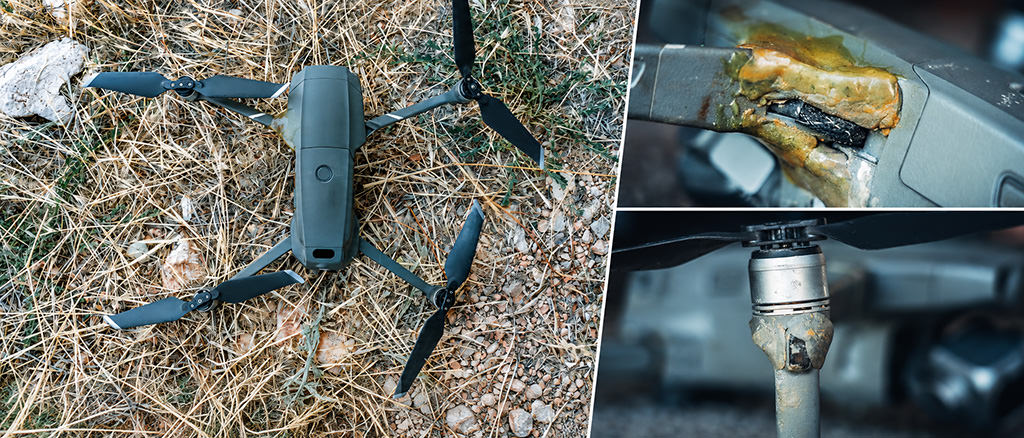
Our drone was no different. If it broke, we fixed it. Glue, tape, epoxy… whatever worked. We kept patching it up until eventually there was a point where even we had to admit:
OK, this thing isn’t flying anymore.
And we had been doing this for years. Clothes, household items, equipment, tools – we repaired things for as long as there was anything left to repair. Throwing something away simply because it was broken was never our first option.
Repair It Until It Falls Apart
Of course, there were exceptions. Some things were simply too important to take chances with, especially anything we used to earn our money. Computers, tablets and other professional equipment needed to be up to date and reliable. In those areas, we didn’t mess around. We bought what we needed and didn’t try to save money at the expense of our work.
For almost everything else, we simply used things for as long as they were still useful and repaired them whenever we could. We only replaced something when there really wasn’t anything left to save.
Food btw, is a very sensible topic to us:
When it comes to food waste, we are pretty uncompromising: we never, ever throw food away simply because it is no longer perfect. Leftovers get eaten, ingredients get used creatively and something that might look a little past its prime to someone else is often still perfectly good to us. Food was produced, transported, bought and paid for, so throwing it into the bin just because we don’t feel like eating it anymore makes absolutely no sense to us.
And if something really has become inedible or has genuinely gone bad, we still try not to treat it as rubbish. Whenever possible, we return it to nature in a way that allows other living creatures to benefit from it. Composting, feeding appropriate scraps to animals or simply putting organic matter back into the natural cycle can give it another purpose instead of turning it into useless waste.
For us, it’s the same principle as with everything else: use it, reuse it and only get rid of it when there really is nothing left to save.
Cars: Where We Never Really Wanted to Save
There is a saying in Germany: “Das Auto ist des Deutschen liebstes Kind” – the “car is the German’s favourite child”. And there is probably more than a grain of truth in it. For many Germans, a car is much more than a means of getting from A to B. It is freedom, status, pleasure and sometimes a rather expensive part of the family.
We were no different in one respect. We were speed freaks and petrolheads. We loved cars. After all, what was the point of working our arses off if we never allowed ourselves to enjoy some of what we earned? Cars were definitely not one of the areas where we tried to save money.
But even here, there was a difference between spending money and wasting money.
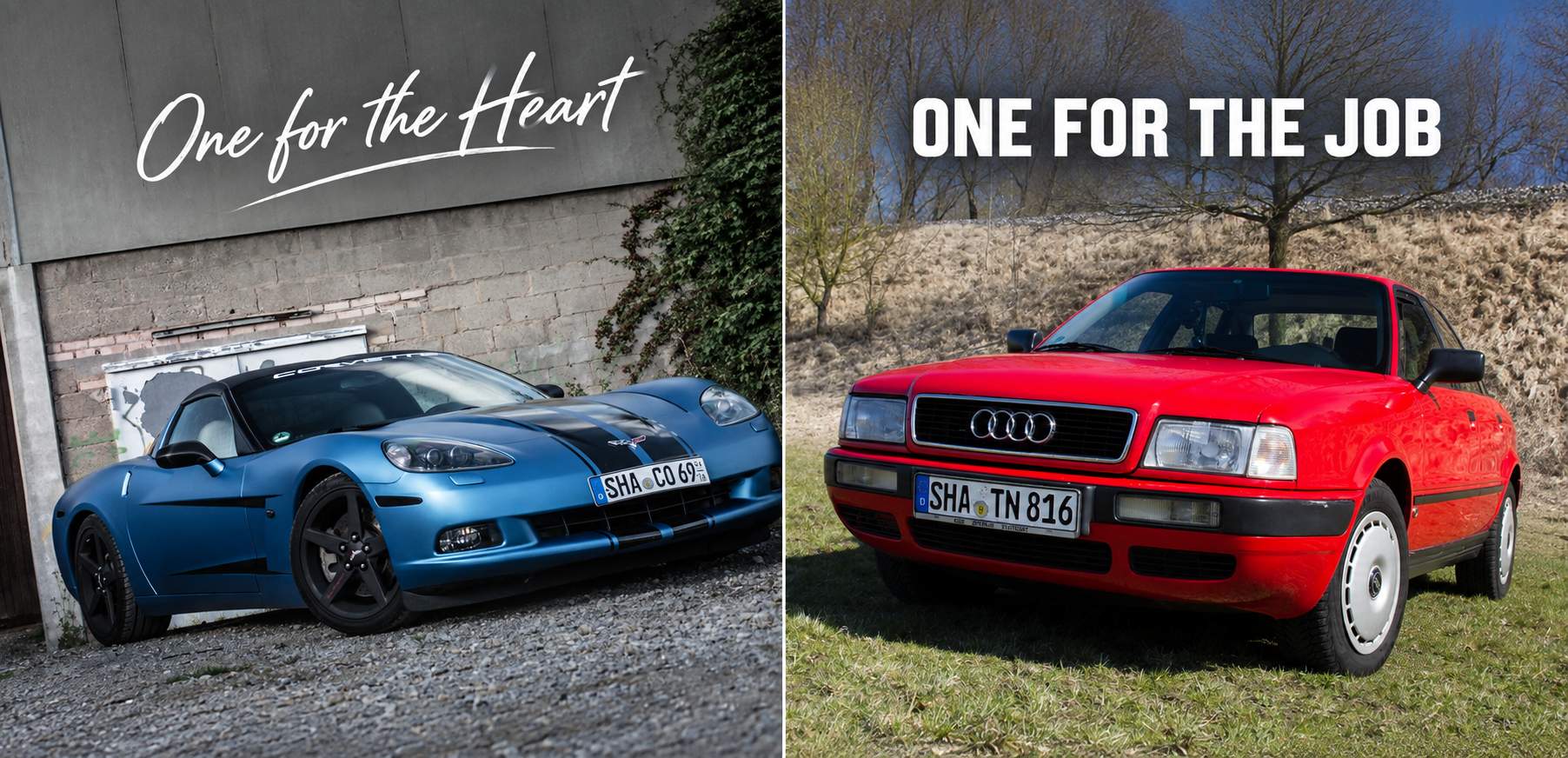
Our 1997 Audi 80, for example, cost us just €700. We barely put any money into it and that old workhorse stayed with us for twelve years. It was the car for our jobs, while the sports car was the one for the soul.
And we couldn’t have cared less what potential clients thought when we turned up at their offices in that old car. In fact, it had one major advantage: it was the perfect understatement car. Nobody expected anything from a 1997 Audi 80, which meant nobody suspected what was sitting in the garage at home.
Looking for a Third Pillar
If you’ve made it this far, respect. You now have a pretty good idea of how we think about money and why we started changing the way we spent it.
All of this certainly saved us some money, but it didn’t actually make us any. It helped pay for the trips we were already taking, but it wasn’t going to turn 2- or 3-week holidays into the kind of travelling life we had started dreaming about.
We wanted to travel more. We wanted a little more financial freedom. And then there was something else we had managed to ignore for far too long: we should probably start saving some money, too.
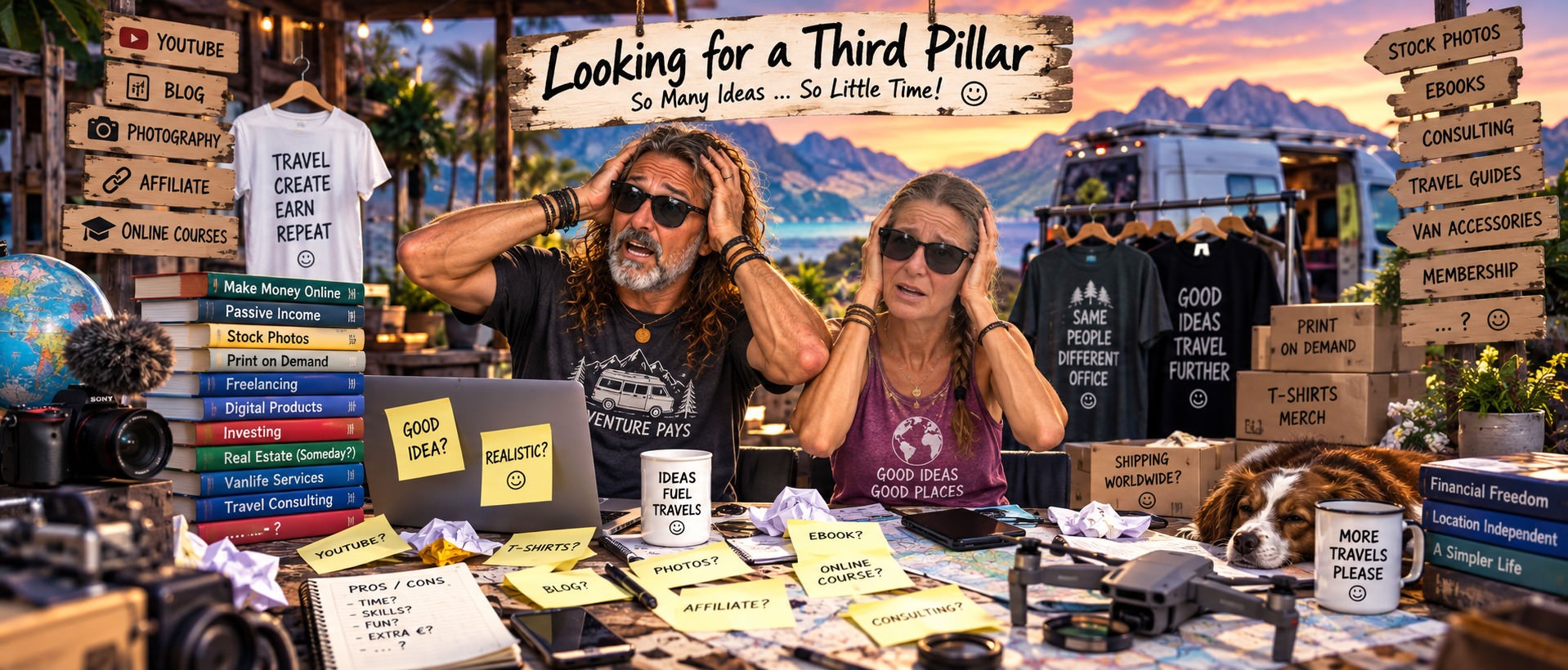
So we started looking for a third pillar. Something that could put a few extra euros into the pot without requiring us to take on another full-time job. We already had regular clients who needed to be looked after, so whatever we did had to be manageable, flexible and ideally something we would actually enjoy. It would also be nice if we could do it in those quiet periods between projects.
We read blogs, watched videos and looked into pretty much every idea that promised easy money. There was no shortage of them, from “How to Get Rich with YouTube Videos” to “Sell Your Own T-Shirts”.
And I dare to say: quite a lot of this advice seemed to come from people who had probably never made any serious money themselves. Some of their ideas about how easy it would be to make a living from them were, frankly, rather optimistic.
Still, a few extra euros would have been a start. We just had to find something that didn’t turn our supposed side income into another job.
Some Worked. Most Didn’t.
We tried quite a few things. T-shirt printing, selling our own designs on Etsy and similar platforms – all of them sounded nice until we looked at the numbers. It quickly became clear that we weren’t creating passive income. We were buying ourselves another job. Designing, uploading, managing orders and dealing with customers was simply too much work for the money involved.
Writing was more interesting. We could do it in relatively little time and, compared with the effort, the income was… well, OK. But some of the requirements for supposedly simple texts were absurd. Even short pieces sometimes had to contain a specific number of keywords, turning perfectly normal sentences into something unreadable and artificial. That wasn’t our idea of good communication.
App and game testing was much more promising. Depending on the day, it was possible to make €70–100, with individual tests paying around €5–30. Finding a major bug before anyone else could bring in a particularly nice bonus. Since we already had years of experience beta-testing professional software, writing proper bug reports was second nature to us and we quickly climbed the tester rankings.
And that was precisely the problem. The higher we climbed, the more invitations we received. Staying near the top meant testing, testing and more testing. It was great fun and the money was good, but it was becoming another job. Great for someone without a job. Not so great for us.
Fenny also tried paid surveys. Some were actually quite interesting, such as watching short advertising clips and then being asked about their effect. Most surveys, however, involved a lengthy screening process before you were eventually told that you didn’t qualify. Earning a few euros this way was possible, but painfully inefficient. And for people travelling permanently, it gets even more complicated. Many surveys are restricted to certain countries, VPNs are often detected and product-testing programmes that send things to your home don’t work particularly well when your home happens to be wherever you parked the van.
Then there was advertising. Fenny knew Google AdSense inside out after running it professionally for clients for years. Technically, it was an obvious possibility for our website. But we rejected it completely. Whenever we visit a website covered in adverts, we usually leave immediately. Some sites seem to contain more advertising than useful information.
Our own website is non-commercial, and we will keep it that way.
Donations were another possibility, but one we didn’t want either. If a blogger, vlogger, traveller or overlander creates valuable content and people voluntarily want to support that work, that’s perfectly reasonable. But relying on donations to finance your own life is a different matter.
We didn’t want our freedom to depend on other people’s generosity.
So far, we had found plenty of ways to make a few extra euros. What we hadn’t found was something that could earn money without constantly demanding more of our time.
Then, in 2010, I happened to discover something that changed the whole picture.
The Bryce Canyon: The Place That Led Us to Passive Income
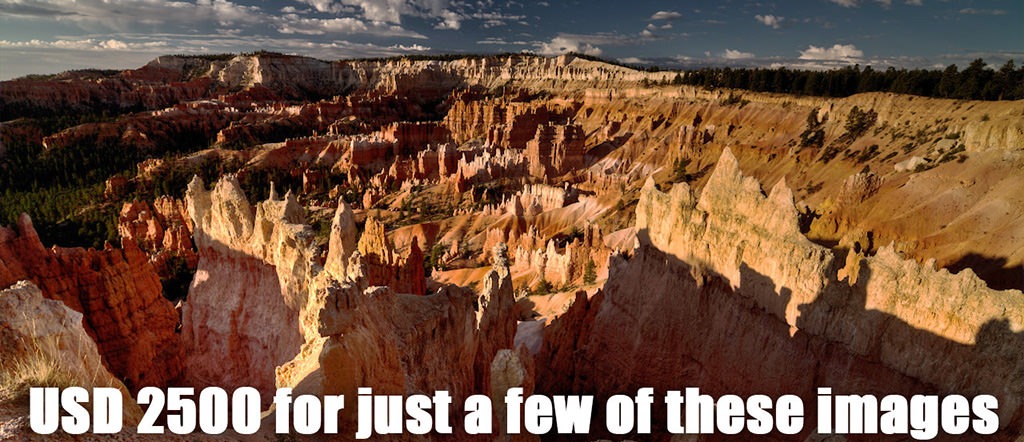
In 2010, we were at Bryce Canyon in Utah. I was already filming our little cinematic country videos and had shot a time-lapse there. At the time, I was also active on Vimeo, where I regularly uploaded a potpourri of my footage.
One day, a Canadian agency contacted me. They were producing an advertising film for the then-new Jeep Cherokee and wanted to know whether they could license one of my shots.
I had absolutely no idea what something like that was worth. There was no AI to ask and certainly no experience on my side to fall back on. So I did what I always do: research.
I eventually let them make me an offer.
US$2,500 for 20 seconds of my time-lapse, of which they actually used only 8 frames
I was speechless.
That got me thinking. There was clearly a business opportunity here. A production company can spend hundreds of thousands of dollars on an advertising campaign. If they need one very specific shot and somebody already has exactly what they need, paying a few thousand dollars for the licence suddenly doesn’t seem so crazy.
And then it clicked: I was filming anyway?!
I was already travelling a lot, already shooting footage and already creating material for my own films. Why not sell those shots as well?
That was when I discovered Stock Footage.
The idea was simple. As a stock footage contributor, you upload your video clips to specialised agencies. Filmmakers, production companies, advertising agencies, broadcasters and other customers can then license those clips for their own projects. You receive a share of the licence fee.
The best part was that I didn’t have to find those customers myself. I filmed the material, edited it, prepared it, added descriptions and keywords and uploaded it. The agencies handled the marketplace, licensing and payment. One clip could then be licensed again and again to completely different customers.
And there was another advantage: I could distribute the same footage through several agencies. At the time, there were around 20 important players, including Shutterstock, Pond5, 123RF, Fotolia, Getty Images and others. One video could therefore be uploaded once and made available in many different marketplaces.
That was the beginning of what became our first almost genuinely passive income stream.
In the early years, the business was fantastic. Several hundred Euros or Dollars for a single 20-second clip wasn’t unusual. But as more and more footage flooded the market, prices inevitably came down. Today, you might get US$50 for a clip on a good day, while many licences pay only a few cents.
Some agencies eventually went too far. When I was offered €0.001 for a video clip, I was out. At that point, I felt less like a filmmaker and more like a prostitute.
So I gradually reduced the number of agencies I worked with. Many of the old players no longer exist anyway. Today, the major names include Shutterstock, Alamy, Adobe Stock, Getty Images, iStock and a few others.
I now have around 25,000 video clips available for licensing. Because the same clips are distributed across several agencies, that translates into roughly 100,000–120,000 potential individual income sources.
And this is what makes stock footage different from the side hustles we had tried before. The work happened when I filmed and prepared the footage. Once a clip is online, it can potentially earn money years later without me having to do anything when someone buys it. No customer service, no shipping, no production and no appointment.
A clip I filmed 15 years ago can still earn money today while I’m sitting somewhere on the other side of the world – and it can keep doing so over and over again.
That’s about as close to passive income as we have found.
I still do it today, although I now concentrate on roughly five agencies. The income currently covers around a quarter of our current travel budget. Before we started our long-term journey, stock footage paid for all of our trips and most of our photography and video equipment.
It all started with 20 seconds at Bryce Canyon and a US$2,500 licence.
Our first almost genuinely passive income stream was born – and it is still alive today.
From Almost Nothing to Our First Investments
As we got older and started dreaming more seriously about travelling, we also started thinking about our financial future. And eventually, we realised that we had made a pretty serious mistake:
We had no savings.
Since we were both self-employed and ran our small 3D agency, we had never paid into the German statutory pension system. Based on what we had accumulated, our pension from the age of 67 would amount to roughly €400 a month – combined. Not exactly enough to live on. And even dying isn’t getting any cheaper.
I still had four life insurance policies: three smaller ones that were due to mature within the next few years and one much larger policy that wouldn’t pay out until I was 69. During one of those quieter periods, when I didn’t have much work, I finally had time to think about what this actually meant for our future.
Shit.
I had simply never thought seriously about it.
So I started researching. And researching. At some point, I remembered something my neighbour had once mentioned. “ETP”, “FTE”, “EFP investment” or something like that? I had no idea what he had been talking about. So I did what I was good at: research.
Eventually I stumbled across ETFs – Exchange-Traded Funds. To me, they were initially complete gibberish and I was sceptical. I wanted nothing to do with speculation on the stock market. But I started watching videos and reading everything I could find. For about three months, I did nothing but learn about investing, day after day. Fortunately, I had no major projects at the time. Looking back, that break may well have saved our financial future.
An ETF is essentially a fund containing a broad range of investments that can be bought and sold on the stock exchange like a share. Instead of betting everything on one company, you can spread your investment across hundreds or thousands of companies with a single purchase.
OK, I thought. Sounds great. But what exactly am I supposed to invest when there’s nothing to invest?
And then I looked at the garage.
Our sports car had been sitting there for quite some time. We simply didn’t have enough time to drive it. It still looked almost brand new and was worth a fair amount of money. I had no idea exactly how much, so I did something rather stupid: I put it up for sale… It was supposed to be just a test. We never actually intended to sell it.
It took only a few hours before someone turned up at our door with a large wad of cash and said he wanted to buy it. I called Fenny at work, practically shaking: “You know that Corvette we never wanted to sell? There’s someone here who wants to buy it right now.“
It was a difficult moment for both of us. But by then, my ETF research had progressed far enough and I had already been running some rather interesting simulations. For the first time, I could actually see that this might work.
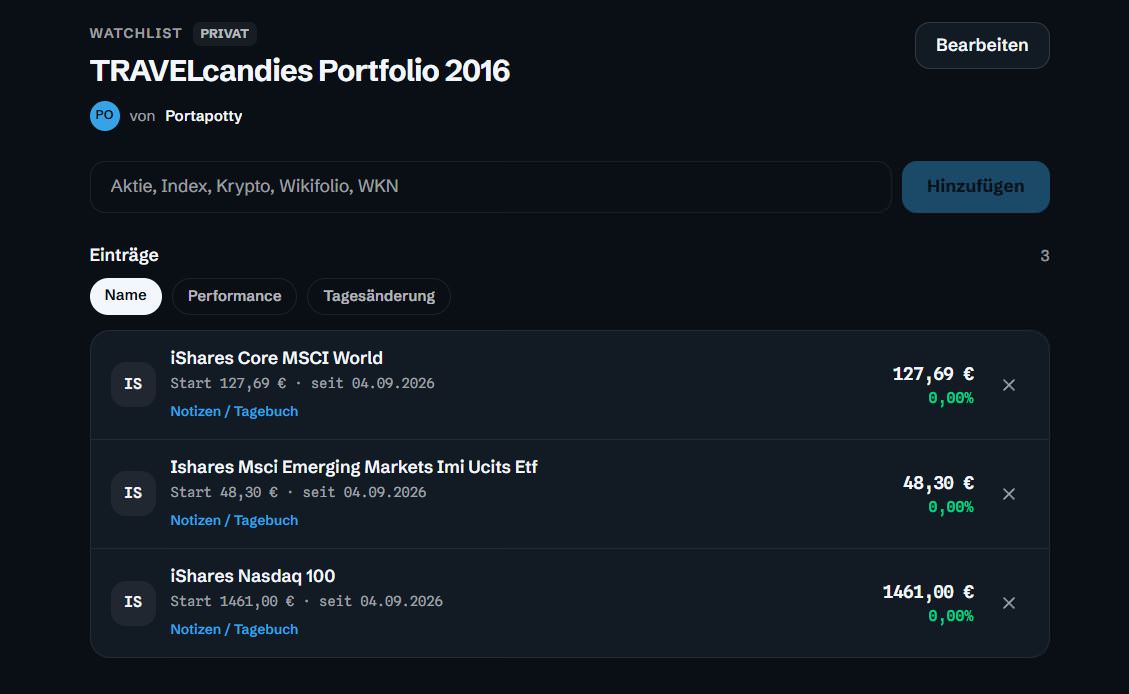
So we sold the car and invested our first five-figure sum in the stock market. We bought a MSCI World ETF, an Emerging Markets ETF and a Nasdaq 100 ETF – essentially a version of the simple “slipper portfolio” based on the ideas of Gerd Kommer.
We deliberately didn’t invest everything. Our approach was roughly 75% invested and 25% kept liquid in the bank.
The funny thing was that we were now invested in the stock market without having the faintest idea what we were doing. We had, at best, a rudimentary understanding. Return, interest, compound interest, dividends – all of these were still pretty new to us.
And I was already 48. We had too little money to invest meaningfully and certainly nowhere near enough to live on in old age. But we wanted to see what was possible, so we left the investment alone and watched.
Then the numbers started moving. Month after month, we watched the value rise and the returns increase. That motivated us. A few new projects here, a bit of stress there, another project or two – and instead of spending everything we earned, we started putting money aside. Within two years, we had accumulated a respectable sum that was working for us every day.
But it still wasn’t enough.
That was when my motivation – and perhaps a little survival instinct – really kicked in.
I started building spreadsheets and running projections:
How much money does a person actually need in old age?
How much would we need, taking inflation into account?
How long could we live on a certain amount?
At what point would the money run out?
How long could we travel with it?
And how much longer could we survive abroad than in Germany?
The result wasn’t frightening. It was frighteningly positive.
I eventually calculated some complete scenarios for our life in Germany, still without seriously considering long-term travel or giving up our home and normal life altogether. The projections looked good. Not fantastic, but good enough.
Together with the future payouts from my life insurance policies, we would be able to live reasonably well. We wouldn’t be rich and we certainly wouldn’t be wealthy. But we wouldn’t be destitute either.
And then came our next trip.
That trip changed everything.
Namibia 2019: The Trip That Changed Everything
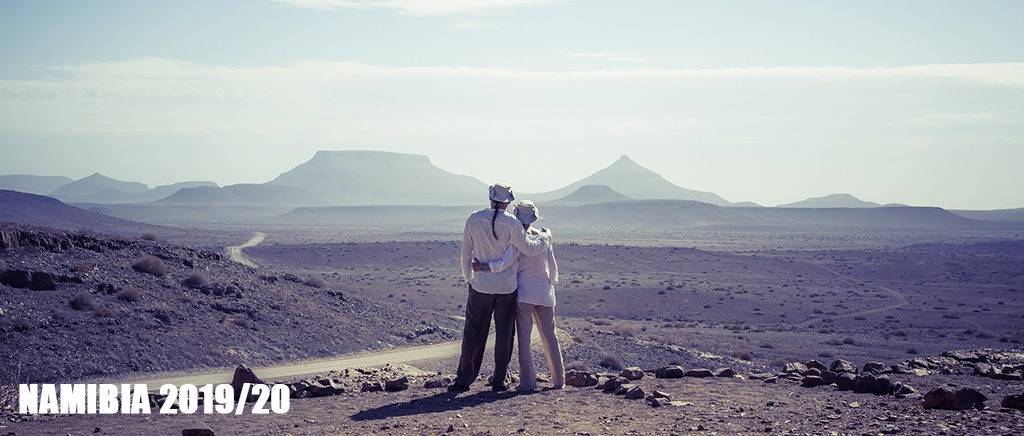
Namibia 2019. What a trip – and ironically, one I had never actually wanted to take. When we returned home in early 2020, I made a completely spontaneous decision. I still have no idea what possessed me, but I simply suggested to Fenny that we should sell everything, leave Germany and go travelling. At first, maybe for one or two years and then we’d see where it took us.
Fenny agreed but quite reasonably asked: And financially? I had no real answer. I had no idea whether our money would actually be enough to finance such a life, but somehow I was determined and surprisingly confident that the stock market would continue to work in our favour. Over the following three years, my three smaller life insurance policies matured and Fenny cancelled her private pension plan. We invested all of it.
The speed of our decision was almost ridiculous. Just three days after I suggested leaving Germany, all our vehicles had been sold. 41 days later, we could have sitting in our van.
Our long-term journey had begun, even though it took us additional 4 months to finally get on the road: COVID came.
Our portfolio temporarily lost a five-figure amount, but there was an important distinction: it was a paper loss. We hadn’t actually lost any money unless we sold. As long as we didn’t sell, nothing had actually disappeared. That knowledge kept us remarkably calm and we continued planning our escape.
For the first year and a half, I still occasionally took on small projects from the road whenever something interesting came along. The money was divided between living expenses and investments, while we checked our overall finances every month. And gradually, something rather surprising became clear: travelling was actually much cheaper than living in Germany. Our life in Germany had cost us around €4,500 a month, whereas on the road we needed roughly €1,000. Of course, that €1,000 still had to come from somewhere, but suddenly the amount we needed to generate was dramatically smaller.
Meanwhile, the stock market recovered and continued climbing. Within about three months, we had recovered the losses from the COVID crash. Things were looking even better than before. Then came Ukraine and another painful market decline. But once again, the market recovered. We were beginning to understand something that had seemed almost impossible when we first started investing: markets go down, markets go up and patience matters.
After two years, we finally admitted to ourselves that this wasn’t going to be a 1- or 2-year adventure. We wanted to travel indefinitely. The problem was that we still had far too many ties to Germany, so we gradually started cutting them. We left professional associations, cancelled our chamber memberships, deregistered the van and got rid of virtually every remaining financial or administrative connection that no longer served a purpose.
Five years into our journey, the numbers still looked good. So after 5.5 years, we finally did the calculation we had been wondering about for a long time:
What had this entire journey actually cost us?
After offsetting everything we could reasonably offset, the answer was almost unbelievable: our 5.5 years of travelling had cost us less than €1,000 in total.
In other words, we had travelled for almost nothing. At the same time, our investment portfolio had continued to grow. Completely contrary to our original expectations, it hadn’t been eaten away by all the years of travelling.
Quite the opposite: at the time of writing, it had reached its highest level ever, despite COVID, the war in Ukraine and the war in Iran.
Even we find that hard to believe. 🤩 Long live ETFs 🤩.
They had performed far better than we had ever dared to expect when we first started investing.
But there is an important distinction we hadn’t fully appreciated yet:
investment returns are one thing, monthly income is another.
And this is where things get really interesting.
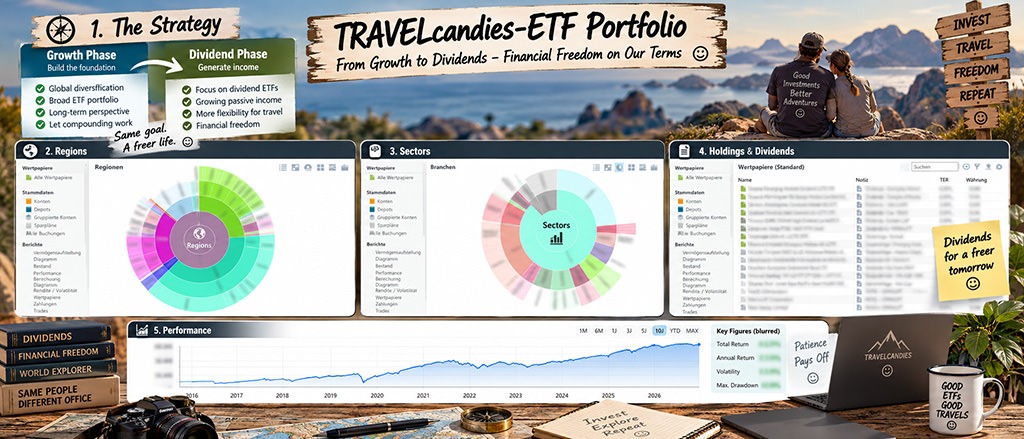
Turning Investment Returns into Monthly Income
The longer we travelled, the more we noticed another problem emerging: travel was getting more expensive. Africa, which had been the most expensive continent for us so far, wasn’t dangerous to our finances yet, but over the long term, rising travel costs would slowly eat into the money we had invested. And that was exactly what we wanted to prevent.
A rising portfolio value is great. You open your account and watch the numbers grow, sometimes by thousands of euros without doing anything. But there is a catch: you can’t live on a rising portfolio value. You only turn that increase into usable money when you sell shares or ETF units. And every time you do that, you reduce the capital that is supposed to keep working for you. If we wanted our investments to finance our travels indefinitely, that wasn’t the solution we were looking for.
What we needed was income from the portfolio rather than constantly consuming the portfolio itself. That led us to look much more closely at dividends. And by this time, fortunately, AI was already available to help us with the enormous amount of research involved.
Return is the overall change in the value of an investment, including price appreciation and distributions. A dividend, on the other hand, is money a company distributes to its shareholders from its profits. With an accumulating ETF, those distributions are normally reinvested inside the fund. With a distributing ETF, they are paid out to the investor. So an ETF can increase significantly in value while paying little or no cash income, or it can generate a higher regular cash flow while having more modest price growth.
Our goal therefore changed. We weren’t looking for the ETF with the highest possible return anymore. We gave the AI a rather simple assignment: less return is perfectly fine if it means more reliable dividend income – but the ETFs should remain stable, ideally stagnate in the worst case and still have the potential to grow in the best case.
After a lot of research and a lot of comparing, we gradually began restructuring our portfolio around dividend-paying ETFs. We deliberately chose funds that weren’t necessarily the strongest performers in terms of capital growth but generated a more useful and predictable cash flow. We also structured them so that, as far as possible, money comes in during every month of the year rather than arriving in a few large annual or quarterly payments.
Without going too far into the technical details, we now have a relatively stable and comparatively low-volatility ETF portfolio focused on dividend income. And those dividends now cover a substantial part of our current travel budget.
But dividends were only the next piece of the puzzle. There was another source of income we could use – one involving tax allowances and the amount we can earn without paying tax – and that became part of our next strategy.
Making the Tax System Work for Us
Each of us has a basic tax allowance – everybody has. In Germany, the “Grundfreibetrag” ensures that a certain amount of taxable income remains free from income tax because it is considered necessary to cover the basic cost of living. In 2026, that allowance is €12,348 per person. For a married couple, that means €24,696 if both have taxable income within the allowance.
And because we were no longer on the regular job market and had no salary coming in, this became particularly interesting for us. Our annual travel expenses were well below the amount of income we could potentially generate before income tax became due. The question was simply: how could we actually make use of the tax allowances available to us?
There is a famous principle in the stock market: Buy and hold. Buy your investments, hold on to the damn things and let them work for you. Yes, you can absolutely do that – and for long-term wealth accumulation, it can make perfect sense. But in our particular situation, there was another possibility worth considering.
Look at a portfolio like ours and the value can move by several thousand euros in a very short time. It might be €5,000 higher one day and €3,000 lower the next. Those numbers are just examples; the point is that market movements can be substantial. We therefore don’t simply buy and hold blindly. When we see that the portfolio has made a significant gain, we can realise part of that gain by selling some ETF units and then buying them back.
Why would we do that? Because the sale turns an unrealised gain into a realised gain. Instead of leaving the entire increase sitting inside the portfolio, we can deliberately realise part of the gain and make use of available tax allowances. Buying the units back means we remain invested rather than taking the money out of the market.
Of course, the actual tax treatment of ETF gains is more complicated than this simple explanation. Investment income is subject to specific German tax rules and allowances, including the “Sparer-Pauschbetrag”, which is €1,000 per person or €2,000 for jointly assessed spouses. ETFs can also benefit from partial tax exemptions depending on the type of fund.
For us, the basic idea was simply this: if we have tax allowances available, why should we let them go unused? When the numbers and the tax situation make it worthwhile, we can realise part of our gains, buy the units back and effectively reset the acquisition price of those units while remaining invested.
It only takes a few minutes when the opportunity arises. Over the course of a year, however, this can create a useful additional benefit.
This became our second-to-last building block.
And there was still one more piece missing.
The Final Piece: Calendars
Now we are finally done demystifying the TRAVELcandies financial situation – and you are almost at the end.
The last piece is a simple one and actually follows exactly the same principle we have already talked about: create something once and let it work for you over time.
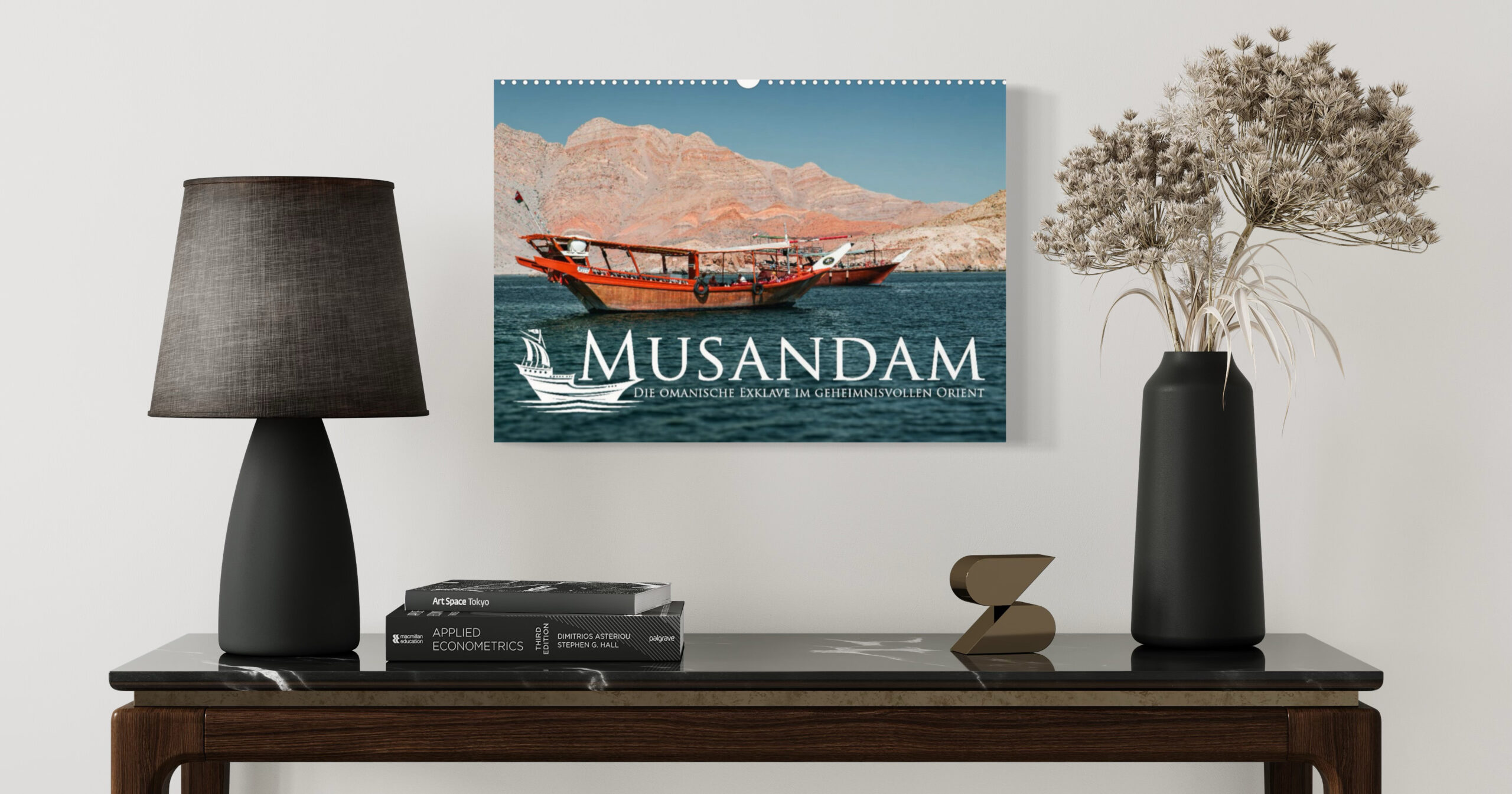
We sell calendars. Not through Etsy or other platforms we consider rather dubious but through a professional publisher that does a good job of marketing and distributing them.
I design the calendars and have them reviewed and approved by several curators while Fenny takes care of the rest. Once a calendar is finished, the publisher handles the marketing and sales.
There is another nice advantage to this model: the better and more popular a calendar is, the more likely it is to be continued in the following years. So instead of creating something from scratch every year, you can create a calendar once and potentially let it earn money for several years. Our calendars have all been accepted for continuation so far.
It works in much the same way as stock footage.
Create it once and let it work for you.
Of course, we’re not getting rich from calendars either. But we genuinely enjoy designing them and working with photographs and we often have plenty of time available for exactly this kind of work. So why not turn something we enjoy doing into another small income stream?
And with that, you have reached the end of the financial demystification of TRAVELcandies.
Bravo – you made it this far 😁
We are financially independent. We don’t receive a single cent from the government, our children or our parents. We do not rely on donations, we aren’t millionaires and we don’t own any real estate. We are simply two ordinary people who did their homework, made some sensible decisions and gradually built a financial structure that allows us to live the life we want.
And the most important thing to us: we didn’t borrow money to finance this journey either.
We are completely debt-free!
That’s really all there is to it – no rocket science 🤷♀️
Based on what we have calculated and under the circumstances we have today, we can travel for a very long time without really having to work.
But there is one important thing to understand: none of this income is guaranteed. Apart from the few hundred Euros we will eventually receive from the state pension and the payout from our life insurance, everything depends on what we already have and how long it lasts.
And that is probably the part many people don’t have on their radar. We are not living from a guaranteed monthly income that someone else pays us.
We are living from what we have – and what we have is supposed to last for the rest of our lives.
So, What Can You Take Away From All This?
Everything and nothing.
In the end, we have really only answered the question you probably had when you heard about us and started us following:
How did we actually create all this and how did we manage to make it work?
None of it is an ingenious strategy, a science or anything particularly innovative. We haven’t revealed some great secret that hardly anyone knows about. Maybe we simply took things one step further than most people do. Maybe we were a little lucky, too. And we certainly made our fair share of mistakes along the way.
One of those mistakes was simply starting too late. Our lives would probably look very different today if we had started putting a little more money aside ten years earlier. We can’t change that anymore. We can only work with what we have today.
And that is really all this answer is: an explanation of what we did.
It is not a handbook, a perfect strategy or a step-by-step guide showing you how to build the same life. We found a way that worked for us. We adjusted it whenever circumstances changed and so far, it has worked surprisingly well. Hopefully, it will continue to do so for many years to come.
But perhaps there is something else you can take away from our story.
You don’t necessarily need to become rich to change your life. You don’t need a million-euro portfolio, a successful startup or some revolutionary investment idea. Sometimes it starts much smaller. Looking at where your money actually goes. Questioning things you have always done simply because everyone does them. Saving a little here, wasting a little less there. Learning something you previously knew nothing about. Finding a way to earn a little extra money. And perhaps, most importantly, figuring out what you actually want your money to do for you.
For us, the answer was travelling.
For someone else, it might be spending more time with their family. It might be living in the countryside, working four days a week, pursuing a passion, starting a business or simply having enough financial breathing room to stop worrying about every unexpected bill.
There is no right way to live a good life.
We genuinely wish that every person on this planet could find a life that makes them happy. It doesn’t have to be a life on the road. It doesn’t have to involve financial independence, early retirement or giving up a regular job. If you love your home, your job, your community and the life you have built, then there is absolutely nothing wrong with staying exactly where you are.
What matters is that the life you are living is your life – not one you are living because you think you are supposed to.
We were simply lucky enough to discover what mattered to us and then, little by little, figure out how to make it possible. Maybe that’s the biggest thing we have learned along the way:
Money never was our goal. Freedom was!
And freedom can look very different for every one of us.
For us, it looks like waking up somewhere in the world without knowing exactly where we will be a few months from now. For you, it might look completely different.
🙏Whatever it looks like, we hope you find it🙏.
And if our story has given you even one idea, one new perspective or simply the courage to question whether the life you are living is really the life you want, then all the numbers, spreadsheets, mistakes and explanations were already worth sharing.
Cheers,
Totti & Fenny
AI Info: I wrote 100% of the original content in German; AI simply helps me turn my thoughts and experiences into better English and SEO-friendly text — real photos are real photos, and AI images should be obvious to every blind chicken 🤗
FAQ – Frequently Asked Questions
What did you guys actually do for a living?
This is probably one of the questions we get asked most often, usually followed by some variation of how the hell we managed to afford all this travelling in the first place.
Fenny worked as a Project Manager | Coordinator | Line Producer, which sounds straightforward until you realise how much was actually involved. Her job was essentially to take a production from the first briefing all the way to the finished product and somehow make sure that all the people, departments, deadlines, budgets and clients involved didn’t completely lose their minds along the way.
She planned and organised productions, coordinated teams and external partners, kept an eye on schedules and budgets, communicated with clients and agencies, organised workflows and made sure everyone knew what they were supposed to be doing and when. When something went wrong – and on productions, something always goes wrong – she was usually one of the people figuring out how to fix it without bringing the entire project to a grinding halt.
Over the years, she worked across a surprisingly broad range of productions: feature films, corporate movies, computer games, advertising films and finally for the automotive industry. She worked for dozens of agencies and more than 170 clients worldwide, moving between completely different types of productions and adapting to whatever the next project required. Her job was not to create the actual images or animations, but to make sure that all the creative work could happen in the first place – and ultimately make it from the first meeting to the finished product.
I worked on the other side of that equation.
For most people, computer graphics artist was probably the easiest job title to understand without having to give them a 20-minute explanation. Over the years, my actual job titles varied considerably, but eventually the industry mostly settled on 3D/VFX Artist.
And that covered a hell of a lot of ground. Depending on the project, I worked as a Character Animation Artist, Facial Animation Artist, Motion Capture Supervisor, Set Supervisor, Character Modeler, Visual Effects Artist and in plenty of other roles. Basically, if something could somehow be created, manipulated or brought to life graphically with a computer, there was a good chance I had something to do with it.
My software toolbox was similarly broad. I worked extensively with the Adobe Creative Cloud family, including Photoshop, After Effects, Premiere Pro and Audition, alongside my main 3D and VFX tools such as Autodesk Maya, 3ds Max and DaVinci Resolve, as well as Substance 3D, ZBrush and various other tools that came and went over the years.
Interestingly, our professional worlds overlapped quite a lot, therefore we always worked together. We both worked extensively in the genres already mentioned, although from different sides of the production process. That was the reason we decided to start a small 3D agency together.
Over the years, we worked on hundreds of projects, ranging from tiny jobs to large international productions, either as a subcontractor, freelancer or directly for clients on site. Some of the better-known names we worked for included Microsoft, Mercedes-Benz, Sony and Intel, alongside more than 170 other clients around the world.
So if you ever wondered what exactly we did for a living, the short version is probably this:
Fenny made sure productions happened. I made pixels do things they couldn’t do on their own.
And between the two of us, we somehow managed to make a living from it for several decades.
Less than €1,000 in 5,5 years in total? Are you kidding?
Absolutely yes and absolutely no.
Yes… in the end, the whole adventure really did cost us just under €1,000. And no, we are not joking.
How does that work?
If you take all our expenses – literally all of them – and offset them against all the income generated along the way through interest, dividends, distributions, passive income and everything else, while at the same time our portfolio didn’t shrink but actually continued to grow, then the amount that effectively disappeared from the portfolio was surprisingly small. In fact, after 5.5 years, we end up at roughly €1,000.
That sounds completely ridiculous until you think about how money actually moves.
A funny example, which reads ridiculous as well:
Imagine a restaurant guest owes the owner €100 and pays the bill. The restaurant owner takes that same €100 and gives it to his mother because he borrowed €100 from her last week. His mother uses the €100 to pay the electrician. The electrician uses it to pay his mechanic. The mechanic uses it to pay his rent. The landlord uses it to pay his tax bill. The tax office pays a contractor who repaired a government building. The contractor takes the €100 to the bar because, well, apparently government contracts are stressful. The bartender uses it to pay the local farmer for the beer ingredients. The farmer uses it to pay the guy who fixes his tractor.
And eventually, somewhere in this completely ridiculous chain, the €100 finds its way back to the restaurant owner because he had previously lent €100 to the very same restaurant guest.
So what happened?
A whole bunch of people paid bills. Services were provided. Debts were settled. Someone got drunk. Someone fixed a tractor. The tax office got its money. And somewhere along the way, the €100 may even have paid for a prostitute’s services before continuing its grand tour of the local economy.
But there were never €1,000 changing hands. There was just the same €100 being passed from one person to another and settling one obligation after another.
The important distinction is between money flowing through an economy and money actually disappearing from your own pocket.
Our travel expenses worked in a somewhat similar way. We spent money on fuel, food, repairs, campsites, ferries, insurance, equipment and everything else. At the same time, however, our investments generated dividends, interest and other returns. We also had passive income from things such as stock footage and later calendars. Those streams kept putting money back into the system while our portfolio itself continued to grow.
So although we had spent a very substantial amount of money over 5.5 years, the amount of our original capital that was actually consumed was tiny in comparison.
That’s why we can honestly say that our 5.5 years of travelling effectively cost us around €1,000.
Not because we lived on €1,000 for 5.5 years. That would be complete bullshit.
We simply managed to create a system where the money kept moving, kept doing its job and, for the most part, came back from somewhere else before we actually had to destroy our capital to pay for the next adventure.
I Think You’re Richer Than You Let On
Dude… if you knew our situation and completely put yourself in our shoes, you would probably talk very differently.
Since we don’t have any more “real” money coming in, living in Germany is no longer an option for us either. Compared with what you need to live in Germany in old age and considering that we don’t have and won’t receive the necessary reserves, we are basically what you would call kinda “poor”🤷♀️.
Believe it or not. That’s just how it is.
So, are you living poorly while travelling?
That depends entirely on how you define poor.
We’ve often been told that we are living on the absolute limit. And measured against some people’s standards, perhaps we are. We can’t – and, more importantly, don’t want to – afford everything. We are perfectly happy with what we have, although there are certainly situations where we wouldn’t mind having a few hundred euros more available.
For us, time is the important factor. The longer we can make our money last and the less our portfolio shrinks, the better our financial situation will be in old age. The money we don’t consume today can continue working for us, and the longer it does, the more powerful the compound-interest effect becomes.
So we are simply waiting to see what the future brings. For now, we are still young enough to enjoy a relatively simple life and we are perfectly comfortable with it. Whether that will still be true when we are old is another question.
Maybe then our definition of enough will change.
Can you tell us more about ETFs?
Yes, I could. But I’m not a qualified financial adviser, and I wouldn’t want to take on that responsibility. Besides, the subject is far too complex to cover properly here. To do it justice, I’d probably have to start an entire blog series about ETFs and investing.
That said, when we’re travelling, I occasionally give interested fellow travellers what I jokingly call a financial refuelling stop – a concentrated crash course in what we’ve learned. Some of them get back in touch months later and tell us they actually followed some of the advice and are now enjoying the results themselves.
And honestly, that makes me very happy. If a few things we learned the hard way can help somebody else achieve a little more financial freedom, then that’s a pretty nice side effect of our journey.
But whether I would actually put all of that out there publicly in a blog?
I’m not so sure.
Can you recommend websites for side income?
Yes, I could. And no, I won’t.
For one thing, I don’t want to turn this article into advertising for other platforms and for another, I don’t particularly feel like creating my own competition. I hope you understand.
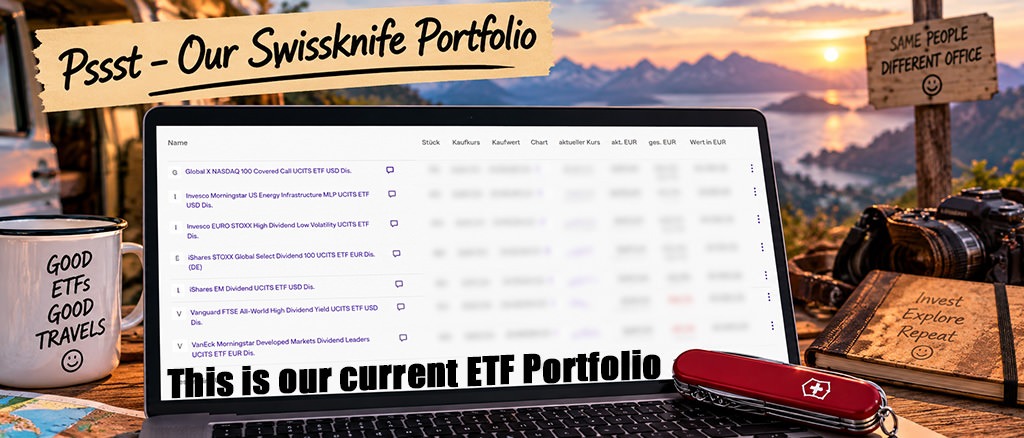
The one thing I can share, however, is our original ETF portfolio (see the last ETF picture), including the individual ETFs we actually use – but obviously without the amounts.
Some of our friends have copied the portfolio, either in full or only partially, and they are very happy with the results so far. But as always: do your own homework and find out what fits your situation, your goals and your risk tolerance. What works for us doesn’t automatically have to be right for you.
What other advice can you give?
Well, here too I have to disappoint you a little. This blog really only has one purpose: to answer a question we get asked again and again and to tell you, completely unfiltered, where we started, what we did and how we ended up where we are today.
It is not meant to be a guidebook, a financial advice column or an attempt to teach people how they should live their lives. We certainly don’t want to tell anyone what to do, how to spend their money or what they should change about themselves. If anything, we’d be happy if our story simply motivates someone to look at their own situation and ask: Could I do something differently?
And that’s probably where the problem starts. A lot of people simply won’t see themselves in our approach. Our way of dealing with money, possessions, work and eventually investments developed over decades and was shaped by our personalities, our mistakes, our circumstances and quite a bit of stubbornness. What worked for us is not automatically going to work for somebody else.
The internet is already full of so-called online coaches who seem to have discovered the secret formula for life. Apparently, all you need is the right mindset, the right morning routine, three hours of meditation and a subscription to their €997 masterclass. Somehow, the person selling you the course always seems to be the one who got rich from telling other people how to get rich.
We are actually surprised ourselves at how well our approach worked. But that doesn’t make it a guarantee, a blueprint or a universal recipe. There is no magic formula here and certainly no promise that you can simply copy what we did and end up with the same result.
And there is one thing I have learned with absolute certainty: people often ask for advice without actually wanting to take it.
You can sit down with someone for hours, listen to their situation, think through the options, discuss the advantages and disadvantages, suggest possible solutions and explain why you think one particular approach might work. They nod, agree, ask questions and sometimes even tell you how helpful the conversation was.
And then they go away and do exactly the opposite.
Not always, of course. But often enough to notice the pattern.
Sometimes they weren’t really looking for advice in the first place. They were looking for confirmation. They already knew what they wanted to do and simply wanted somebody else to tell them that it was a good idea. And when the advice doesn’t fit what they wanted to hear, they conveniently ignore it.
That’s perfectly human. We have probably all done it at some point. Asking for advice is easy. Acting on advice is the difficult part, especially when it means changing something we actually like about our lives.
So if you are looking for ten magical tips that will make you financially independent, I’m afraid you’ve come to the wrong place. We don’t have them.
What we have is a story about two ordinary people who made plenty of mistakes, changed their thinking several times and eventually found a way that worked surprisingly well for them.
Maybe there is something in it that works for you, too. And if not, that’s perfectly fine. At least now you know what we did.
Do you still have to deal with taxes?
Yes, of course. Just because we don’t have to pay any income tax in a particular year doesn’t mean the tax office suddenly forgets that we exist.
There is a very important difference between having no tax to pay and having no tax obligations. We still have to file tax returns, declare our relevant income and investment income and provide the information required by the German tax authorities. Depending on the type of income and where it comes from, there can also be different reporting and taxation rules that have to be taken into account.
Our situation is also not quite as simple as saying we have no income. We have dividends, investment income, passive income and occasional other earnings. Some income may be covered by allowances while other income can be subject to taxation under completely different rules. And then there are things like capital gains, withholding tax and the various special rules surrounding investment income.
So yes, we still spend time dealing with taxes. We simply don’t spend it paying taxes we don’t actually owe.
And that’s an important distinction for us. We are not trying to hide anything, avoid filing returns or somehow disappear from the tax system. Quite the opposite: we declare what needs to be declared and let the tax authorities calculate what is actually due.
If the result is that the final tax bill is zero, that’s not tax evasion.
That’s simply the result of the rules being applied to our particular situation.
Are you really traveling full-time?
Yes. And I mean full-time.
There are plenty of so-called full-time travellers out there who proudly claim to have been travelling for 10, 15 or even 20 years, while spending half of every year back in their home country – sometimes even working there. That’s certainly a form of long-term travel, but for us, it isn’t full-time travel.
We don’t work anymore and we don’t take six-month breaks to return home, earn some money and then head off again. Since we left Germany, travelling has been our normal life. Full-time means full-time – without a built-in interruption.
That doesn’t mean we intend to drive around forever without ever stopping. In the future, we actually want to become a little more flexible about this. If the climate becomes unbearable somewhere, if we’ve simply had enough of a particular country or if we feel like taking a proper break from the road, we might leave the vehicle somewhere safe and fly somewhere else for a while.
Maybe we’ll spend a few weeks somewhere completely different, perhaps enjoy a city, visit friends or simply do absolutely nothing for a change.
We’ll see.
For now, though, full-time means exactly what it says: at the moment – 6 years on the road – 24/7
Do you guys miss your former life and your jobs?
The first part of our life was great, and we genuinely loved it. We had good times, travelled whenever we could, built careers, enjoyed ourselves and lived a life that suited us at the time. But that was the first part of our life. It was good, it was ours and we have absolutely no desire to go back.
We don’t miss our former life. Not even a little. The second part of our life is what we are completely focused on now, and there is still far too much of it ahead of us to spend our time looking backwards.
But if you ask us whether we miss our jobs?
Yes. Both of us. Very much.
I probably miss mine even more than Fenny misses hers. I took my original childhood dream, turned it into a hobby and eventually somehow managed to turn that hobby into my profession. For me, it was quite simply the best job on the planet. I loved what I did, I loved the creative side of it and I loved being able to make a living from something I would probably have done anyway.
So yes, I miss my job. Quite a lot, actually.
But there is an important distinction: missing something doesn’t necessarily mean you want it back. My job was part of the first chapter of our life. A bloody good chapter, too.
But it was still Part One. 😉
Ever want to go back?
No. At least, we currently have absolutely no intention of going back to Part One.
But who knows what the future will bring?
We are getting older, after all. At some point we might need help, one of us might become seriously ill or we might simply run out of money. Any of those things could force us to change our plans. And if it is the last one, that would also be the first time we would accept help from the state.
We have paid a hell of a lot of taxes throughout our working lives. So if one day we genuinely need state support, we won’t feel guilty about accepting whatever we are entitled to. That’s what the system is there for.
But as long as we can avoid that situation, we will avoid it.
For now, Part Two is still the part of our life we want to live. And we’re not particularly interested in writing Part Three just yet😁
What do you do, when money runs out?
We sincerely hope that never happens. At the same time, we are very much aware that our portfolio will eventually be depleted — or may have to be depleted — at some point.
After hundreds of calculations and simulations, it is highly unlikely that money will become seriously tight before we reach official retirement age. But yes, the risk is there. Markets don’t always recover quickly after a war, and nobody knows how long our passive income from stock footage will continue. So far, things look pretty good. But we know better than to assume that they will stay that way forever.
Our rather ridiculous German pension doesn’t exactly add much stability to the equation either.
So what will we do?
Honestly: we don’t know yet. What we do know is that we’ll notice when things start getting tight, and we’ll adjust accordingly. Reduce expenses, change the portfolio, generate additional income or alter our travel plans — whatever is necessary at the time.
That’s about all we can do in our particular situation. As I said earlier, we simply started too late, and our level of risk is probably higher than it would have been if we had started planning for this much earlier in life. We know that.
But for now, the numbers still work. And as long as they do, we’ll keep going.
And at the very end, we simply stop travelling!
If we can no longer afford our travelling lifestyle, nobody else is going to pay for it.
Do you make money from the Blog, Youtube or Patreon?
Simply no… not a single cent!
We don’t make money from the blog – and honestly, how would we? – and we don’t make money from YouTube either. I deliberately keep both as small as possible for as long as I can. They are there because I enjoy sharing our experiences, not because I want to turn every click into another source of income.
And Patreon?
Asking people to donate money to finance my life while they are probably struggling with their own finances?
I’ll put it this way:
I’d rather stand on my head and catch flies with my arse.
I think that says pretty much everything. 😉
But surely you'll inherit something one day?
Honestly?
I don’t give a shit, and I don’t want to talk about it.
I’ve told my parents exactly one thing: Spend your money. You only get one life.
I don’t want to inherit anything. In fact, I hope my parents outlive every expectation.
We have also never included a potential inheritance in any part of our life planning. As far as our financial plans are concerned, that money simply doesn’t exist.
As for how Fenny feels about inheritance… I’ve never even asked. It’s a taboo subject between us.
Isn't that all a bit risky / unreasonable?
Oh yes. Absolutely. And I’ve mentioned that several times already: there is risk involved.
I tend to see it a bit like Charles Darwin put it:
“It’s not the strongest who survive, but the most adaptable”
We know that our situation could change. Markets can crash, passive income can disappear, unexpected expenses can come along and our health won’t improve with age. That’s why we don’t simply assume that everything will continue working exactly as it does today.
Instead, we keep watching the numbers, stay flexible and adapt when circumstances change. We don’t have a perfect safety net, but we do have the ability to change our plans if necessary.
We are also willing to take calculated, manageable risks. That was part of our job, too. As freelancers working in a creative and technically demanding industry, we’ve spent decades making decisions where there was never a 100% guarantee of success. You learn to assess the risks, understand the possible consequences and decide whether they’re worth taking.
That’s pretty much how we approach our life as well.
For us, that’s the key difference between taking a calculated risk and simply being reckless.
What will you do later in life, when you are too old to travel?
Our entire financial planning is based on the assumption that we will both live to exactly 97 years old. Please don’t ask why – that’s a much longer story 😉
But what do I actually want for our old age, once we can no longer travel?
Honestly, not much.
I imagine a little mountain cabin somewhere, or perhaps a palm tree providing some shade by the sea. A bench, my wife sitting next to me, some good music playing and the two of us simply enjoying being together.
And when we get really old, one of us can clean the other’s dentures😁.
We don’t expect much more than that.
Wait! Now I know how big your portfolio is!
Hahahaha😂… Do you?
yeah… you really think I haven’t already done that myself?
Asked AI how big it thinks our portfolio might be?
You’re clever, but I’m cleverer. 😉
Jokes aside: go ahead and try it. I can tell you one thing, though: after giving this blog to pretty much every AI I could get my hands on and asking them to analyse it, the results were honestly quite frightening.
Which, in a weird way, is actually a compliment to us.
And no. No and no again.
Our portfolio is nowhere near as large as the AI seems to think it is. Not even remotely.
If it were actually as large as some of these AI calculations suggest, we’d be in an absolutely fantastic financial position and I could honestly say that we wouldn’t have to worry about money for the rest of our lives.
So there you have it.
I can take that particular dream away from you.
Sorry… for you and for us. 😉