
The Ultimate DHL Express Shipping Guide: Everything You Need to Know
In This Article
Before we begin, one thing is important: this is not a sponsored article, and we’re not affiliated with DHL in any way. We pay for every shipment ourselves, just like everyone else.
Over the past few years, we’ve shipped countless packages, documents and urgently needed spare parts around the world. We’ve used different courier solutions and learned a lot along the way.
Is DHL Express perfect? No. Like every logistics company, they make mistakes. But compared to the alternatives we’ve experienced, DHL Express has consistently been the most reliable option. You might pay a little more (sometimes even way more), but in our experience, that extra cost is often insignificant compared to the value of receiving an important shipment quickly, safely and with minimal hassle.
Many people blame DHL Express when something goes wrong. Sometimes that’s justified. But surprisingly often, the real problem started long before the package entered the DHL network. Incorrect customs documents, incomplete addresses, poor packaging or unrealistic expectations are among the most common reasons for delays and complications.
The good news is that most of these problems are completely avoidable. This guide explains how DHL Express works, where the common pitfalls are and – most importantly – how to avoid them. If you follow the advice in this article, you’ll dramatically increase the chances that your shipment arrives quickly and without unnecessary stress.
Why DHL Express?
Before using any shipping company, we do our research. We don’t just compare prices, we evaluate the entire service.
We start with the website. Is it user-friendly, transparent and easy to understand? Can we quickly find the information we need, or is everything hidden behind endless menus?
Then we test customer support by asking a few questions. How responsive are they? Are the answers actually helpful?
Finally, we compare shipping costs. Surprisingly often, other courier services cost about the same or are only slightly cheaper than DHL Express. But that’s usually where the problems begin: limited international coverage, poor tracking, confusing customs procedures or unreliable local partners.
Is DHL Express perfect? Definitely not. We’ve had our share of frustrating experiences, and customer support isn’t always as helpful as we’d like. But after years of shipping parcels and vehicle parts around the world, we still consider DHL Express the most reliable choice.
DHL Express is the one-eyed king among the blind.
Sometimes paying a few Euros more is well worth it when you know your shipment has a much better chance of arriving quickly and safely.
What Is DHL Express?
Many people use the terms DHL and DHL Express interchangeably, but they are not the same service.
DHL Express is the premium international courier service. Shipments are transported through DHL’s own global network, offering fast delivery, detailed tracking and integrated customs clearance. In many countries, parcels can arrive within just 1–5 business days.
DHL Parcel is the standard parcel service. It is generally slower, tracking may be less detailed and international deliveries often rely on local postal services once the parcel reaches the destination country.
DHL Express vs. DHL Premium vs. Standard Shipping
In many countries, DHL offers three different shipping options: Standard, Premium and Express.
Standard Shipping is the most economical option, but also the slowest. Delivery times can vary considerably, especially for international shipments and tracking is often less detailed.
DHL Premium sits between Standard and Express. In theory, Premium shipments receive higher priority than Standard shipments, which can result in slightly faster delivery. In practice, however, we’ve rarely seen a noticeable difference that justified the additional cost.
DHL Express is the fastest and most reliable service. Shipments travel through DHL Express’ dedicated global network, receive priority handling from pickup to delivery and usually clear customs much faster.
Based on our own experience, we’d either choose Standard if time isn’t critical, or Express if the shipment is important.
How Much Does DHL Express Cost?
Let’s be honest: DHL Express is very expensive. In many cases, shipping costs exceed the value of the items inside the package.
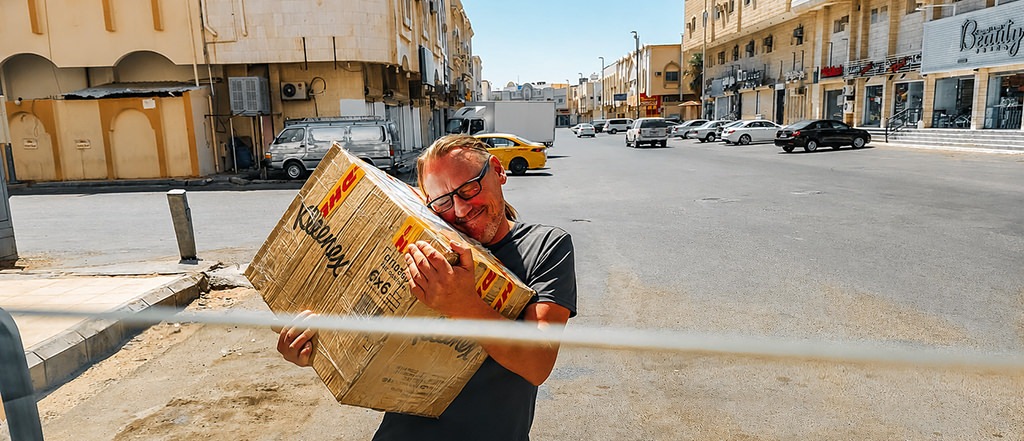
A good example from our own travels: we once shipped brakes and an alternator to Saudi Arabia. The parts themselves were worth around €200, while DHL Express shipping cost almost €400.
At first glance, that sounds absurd. But when your vehicle is stranded hundreds or even thousands of kilometers from home, the calculation changes completely. Waiting several weeks for a cheaper shipment could mean paying for hotels, extending your stay (overstay-problem), changing travel plans or simply losing valuable time. In situations like these, the shipping costs quickly become the smaller part of the overall expense.
The price of a DHL Express shipment depends on several factors, including the destination country, actual weight, package dimensions, volumetric weight and additional charges such as fuel or remote area surcharges.
(Check out the DHL Zone Guide 2026: Download PDF)
Example: A parcel measuring 25 × 20 × 20 cm, weighing 2 kg and containing goods worth approximately €100, typically costs between €114 and €149 to ship with DHL Express, depending on the destination country.
One factor that surprises many first-time users is volumetric weight. DHL doesn’t always charge based on what a package weighs. Instead, large but lightweight parcels may be charged according to the space they occupy during transport. That’s why two packages with the same actual weight can have completely different shipping prices.
DHL Express isn’t designed to be the cheapest shipping option. It’s designed for shipments where speed, reliability and predictable delivery are worth paying for. In many situations, especially when traveling, that extra cost can save far more money than it adds.
Customs and Import Duties
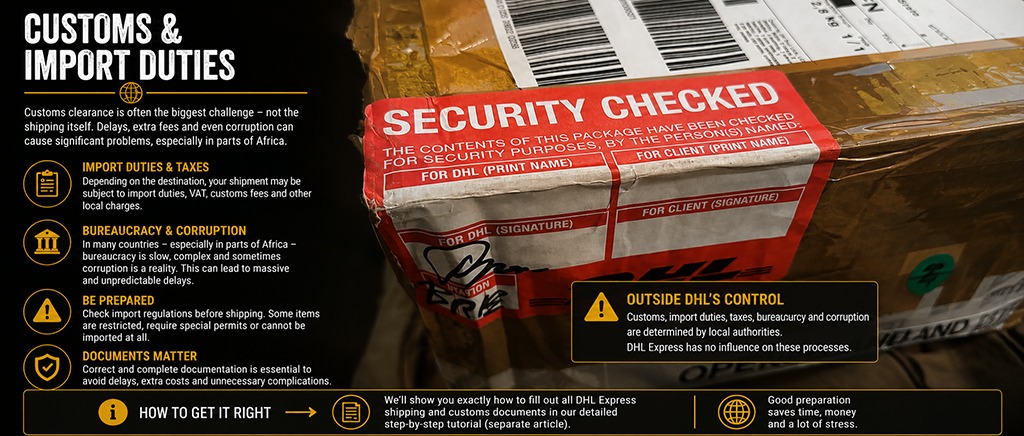
For many international shipments, customs clearance is far more likely to cause delays than DHL Express itself. In our experience, most problems are not caused by the courier, but by incorrect paperwork, incomplete information or misunderstandings about local import regulations.
Depending on the destination country, your shipment may be subject to import duties, VAT, customs processing fees or other local charges. These costs are determined by the customs authorities, not by DHL Express.
Another factor that shouldn’t be underestimated is the efficiency of the destination country’s customs system. In some parts of the world – particularly in parts of Africa – bureaucracy can be overwhelming, processes are often slow and unfortunately, corruption still exists. Even perfectly documented shipments can end up sitting in a customs warehouse for days or even weeks. These delays are entirely outside DHL Express’ control.
Before shipping, always check the import regulations of the destination country. Some items are restricted, require additional documentation or cannot be imported at all.
The good news is that many customs-related problems are preventable. In a separate step-by-step guide, we’ll explain how to correctly complete all required shipping and customs documents to minimize the risk of delays, additional costs and unnecessary complications.
Required Documents
Before DHL Express generates any shipping documents, you first need to set up your shipment correctly. This is one of the most important parts of the entire process.
You’ll be asked to enter information such as the sender and recipient details, package dimensions and weight, the contents of the shipment, its value and the purpose of the export. The quality of this information directly affects how smoothly your shipment passes through customs.
Once you’ve completed the shipment correctly, DHL Express automatically generates all required documents.
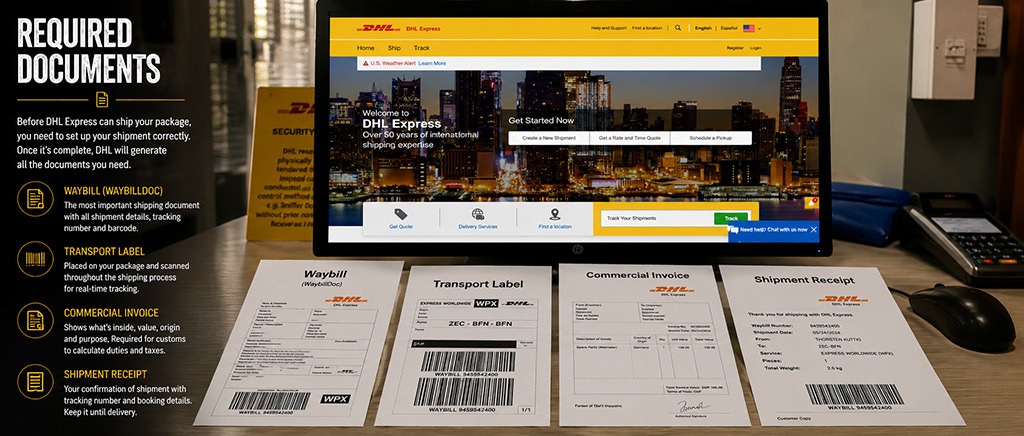
For a typical international shipment, you’ll usually receive the following files:
Waybill (WaybillDoc)
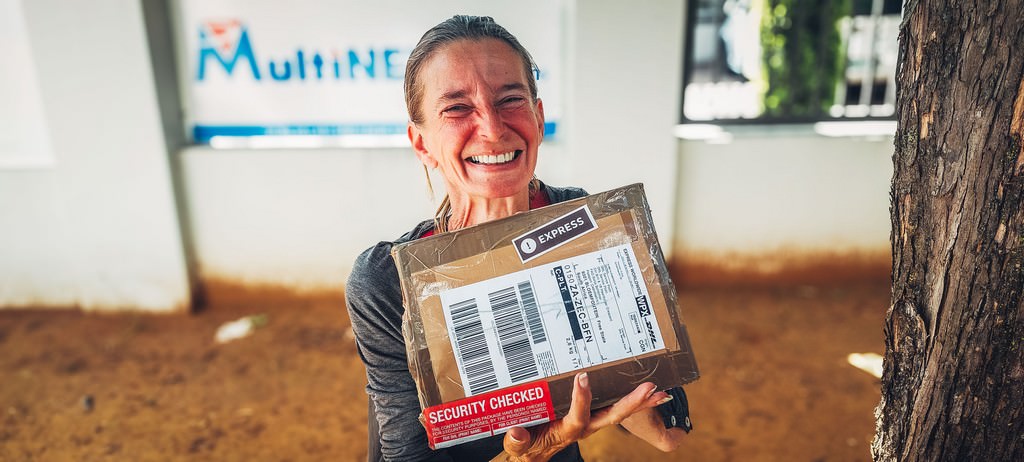
This is the most important shipping document. It contains the shipment details, sender and recipient information, barcode and tracking number. Attach it securely to the outside of the package so DHL and customs can identify your shipment throughout its journey.
Transport Label
The transport label is placed on the package and is scanned at every stage of the shipping process. It enables real-time tracking and ensures the parcel is routed through DHL’s global network.
Commercial Invoice
This document is required for most shipments containing goods. It tells customs what is inside the package, its value, country of origin and the purpose of the shipment. Customs authorities use this information to calculate import duties and taxes.
If you’re sending non-commercial items, DHL may generate a Proforma Invoice instead of a Commercial Invoice.
Shipment Receipt
This is your confirmation that the shipment has been created. It contains useful information such as the tracking number, shipment reference and booking details. Keep it until your parcel has been delivered.
All of these documents are generated automatically by DHL Express. While that makes the process much easier, the information you enter is still your responsibility. Incorrect descriptions, inaccurate values or missing details can lead to customs delays, additional charges or even the return of the shipment.
Because this step is so important, we’ve created a separate, detailed tutorial that explains exactly how to set up a DHL Express shipment from start to finish. It covers every field you’ll need to complete, explains the purpose of each document and highlights the most common mistakes that can lead to customs delays or additional charges.
DHL Express Tracking Explained
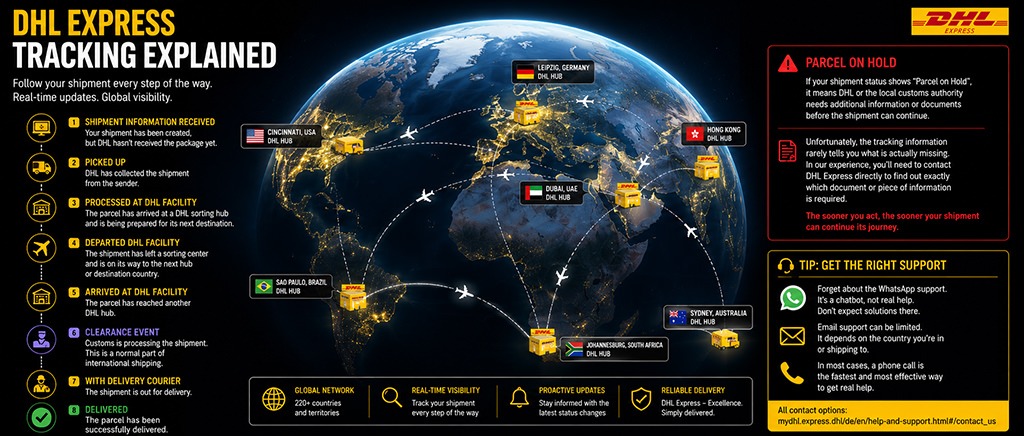
One of the biggest advantages of DHL Express is its detailed tracking system. Every important step of your shipment is recorded, allowing you to follow its journey almost in real time.
Typical tracking updates include:
Shipment information received – Your shipment has been created, but DHL hasn’t received the package yet.
Picked up – DHL has collected the shipment from the sender.
Processed at DHL Facility – The parcel has arrived at a DHL sorting hub and is being prepared for its next destination.
Departed DHL Facility – The shipment has left a sorting center and is on its way to the next hub or destination country.
Arrived at DHL Facility – The parcel has reached another DHL hub.
Clearance Event – Customs is processing the shipment. This doesn’t necessarily mean there’s a problem; it’s a normal part of international shipping.
With Delivery Courier – The shipment is out for delivery.
Delivered – The parcel has been successfully delivered.
Don’t panic if your shipment doesn’t move for a day or two. Tracking updates aren’t always instant, especially while a package is in transit between continents or waiting for the next available flight.
If a shipment remains on the same status for several days, especially during customs clearance, it’s worth contacting DHL Express or the recipient. In our experience, a quick phone call or providing a missing document can sometimes save days of waiting.
If the tracking status changes to “Parcel on Hold”, don’t ignore it. In many cases, DHL Express or the local customs authority requires additional information or documents before the shipment can continue.
Unfortunately, the tracking information rarely tells you what is actually missing. It usually only indicates that the shipment is on hold. In our experience, you’ll often need to contact DHL Express directly to find out exactly, which document or piece of information is required. Once you know what’s missing and provide it promptly, the shipment can usually continue without further delay.
Tip
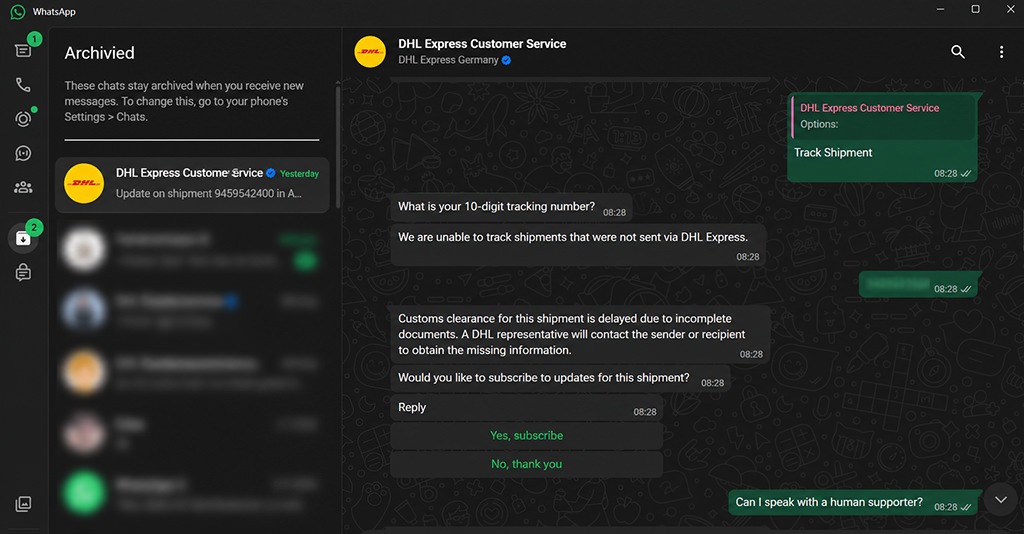
Forget about the WhatsApp support. In our experience, it’s powered by a simple chatbot that isn’t even AI, particularly helpful and is unable to solve anything beyond the most basic questions.
Email support can also be hit or miss. It largely depends on the country you’re shipping from or to. In many cases, a phone call is the fastest and most effective way to resolve a problem, especially when a shipment is being held by customs or requires urgent action.
You can find all official DHL Express contact options here:
One final tip: Tracking tells you where your shipment is – but not always why it’s there. Customs inspections, flight capacity, weather, public holidays or local regulations can all affect delivery times without being immediately visible in the tracking history.
Common DHL Express Problems
Even with DHL Express, international shipments don’t always go according to plan. In our experience, these are the most common issues you’ll encounter:
Customs Requests Additional Documents
One of the most frequent reasons for delays is that customs requires additional information. This may include proof of value, invoices, identification, or other import documents. Unfortunately, the tracking information often doesn’t tell you exactly what’s missing, so you’ll usually have to contact DHL Express to find out.
Shipment Stuck in Transit
Sometimes a shipment appears to stop moving for several days. This doesn’t necessarily mean it’s lost. It may be waiting for customs clearance, the next available flight, or local processing. If the status doesn’t change for an unusually long time, it’s worth contacting DHL.
Recipient Cannot Be Reached
If DHL cannot reach the recipient by phone or email, delivery may be delayed or the shipment may be placed on hold. This is especially common when phone numbers are incorrect or missing. Always make sure the recipient’s contact details are complete and accurate.
Incorrect or Incomplete Address
A missing house number, incorrect postal code or inaccurate address can delay a shipment or even result in it being returned to the sender. Always double-check every address before confirming the shipment.
Shipment Reported as Damaged
This is rare, but it does happen—and our own experience shows that it isn’t always true.
While traveling through Saudi Arabia, we waited more than a month for an urgently needed spare part. Suddenly, the tracking showed that the package had been damaged and was scheduled to be returned to Germany—without anyone contacting us first.
We immediately drove across Jeddah, visiting several DHL facilities until we finally intercepted the shipment.
The result? The parcel wasn’t damaged at all. The cardboard box had a few scratches, but the contents were perfectly fine.
That experience taught us an important lesson: never assume that the tracking status tells the whole story. Mistakes happen. Automated decisions can be wrong, and packages are sometimes classified incorrectly.
Whenever something looks unusual, don’t simply wait. Be proactive, contact DHL Express and ask questions. In many cases, acting quickly can prevent days – or even weeks – of unnecessary delays.

Practical Tips We Highly Recommend
After shipping dozens of parcels to countries across Africa, the Middle East and beyond, these are the lessons we’ve learned – sometimes the hard way.
1. Create your shipment online
Always create your shipment using the official DHL Express shipping portal:
https://mydhl.express.dhl/gb/en/auth/login.html
It offers the most options and gives you full control over your shipment.
2. Don’t use your smartphone
Create your shipment on a desktop or laptop computer.
The mobile version hides or simplifies several important options. On a larger screen it’s much easier to review every field before submitting your shipment.
3. Be extremely precise
Small mistakes can cause major delays.
Pay particular attention to:
sender and recipient details
phone numbers
email addresses
package dimensions
package weight
customs value
product descriptions
HS codes (if applicable)
complete delivery address
4. Use your own name first
If you are receiving the parcel, always list your own name first.
Use the location owner only as:
c/o John Smith
Never the other way around.
This makes it clear that you are the importer and recipient – not the hotel, campsite or business.
5. Avoid hotels and campsites whenever possible
This is probably one of the biggest lessons we’ve learned.
Shipping directly to hotels, lodges or campsites can easily create the impression, that the shipment is intended for a business.
That can result in:
additional customs charges
different tax calculations
unnecessary questions
DHL having to modify customs paperwork
additional DHL service fees
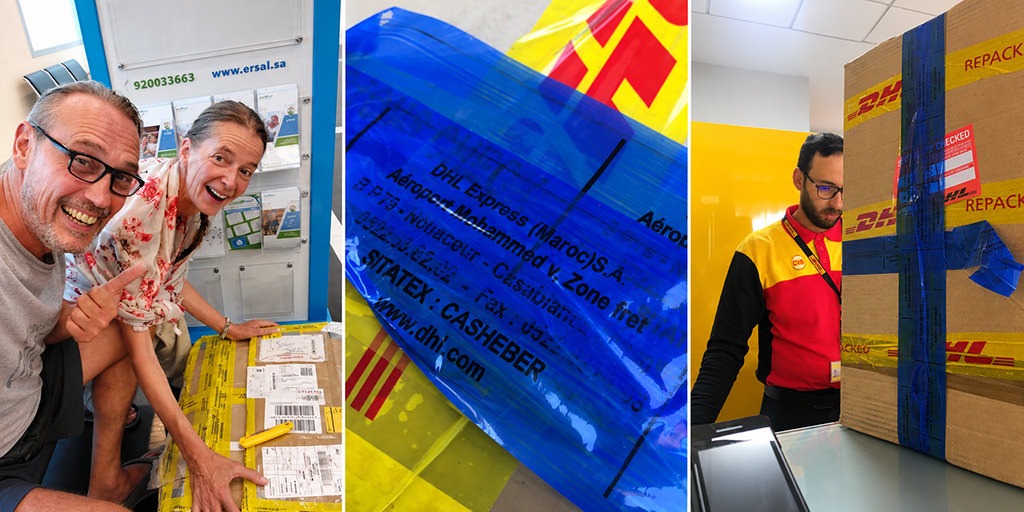
Instead, we almost always ship directly to a DHL Service Point.
We search Google Maps, verify with Street View that the location actually exists, call the office beforehand and ask how long they’ll hold the parcel.
Mostly we even visit the office personally before the shipment is sent.
Our shipping address then looks like this:
Your Name
c/o DHL Service Point
Full DHL Address
This has proven to be the most reliable solution during our travels.
6. Stay inside the DHL network
Whenever possible, choose a service that remains entirely within the DHL Express network.
As soon as a shipment is handed over to the national postal service, tracking often becomes unreliable and problems become much harder to solve.
We’ve experienced exactly this in Saudi Arabia, where the local postal service caused far more issues than DHL Express itself.
7. Include documents twice
Place one complete set of shipping documents inside a transparent pouch on the outside of the parcel.
Add another complete set inside the package.
If the outer documents are damaged or lost, customs can still identify the shipment.
8. Make it obvious it’s for private use
Whenever applicable, clearly state phrases such as:
Private Use
No Commercial Value
No Resale
Not for Commercial Purposes
Tourist Use
Vehicle Repair
Will Be Exported Again
If the items are only temporarily imported, make that absolutely clear.
9. Optimise package size and weight
DHL pricing often changes at specific thresholds.
Increasing a package by only 1 cm or a few grams can sometimes increase the shipping cost dramatically.
Experiment with different package dimensions and weights before confirming the shipment.
10. Don’t ship unnecessary items
International Express shipping is expensive.
Avoid sending inexpensive items such as clothes, snacks or souvenirs simply to fill empty space.
Almost every additional item increases paperwork, customs complexity and shipping costs.
11. Keep the number of different items low
Every different product may require its own customs declaration and tariff classification (HS Code).The more different items you include, the more complicated customs clearance becomes.
Whenever possible:
combine similar items
keep descriptions consistent
scan every purchase receipt
weigh each item individually
12. Pack professionally
Protect your shipment properly.
If DHL determines that damage occurred because of inadequate packaging, insurance claims may be rejected.
13. Use English only
Complete every customs description and shipping document in English.
If you’re unsure about wording, use AI to formulate accurate product descriptions.
Poor wording is one of the most common causes of customs questions.
14. Keep every document
Save:
invoices
emails
tracking history
customs correspondence
shipping documents
You’ll be glad you did if a dispute arises months later.
15. Photograph everything
Before packing:
photograph every item
ideally place it on a scale showing its weight
take one final photo showing all items together
These photos can be extremely valuable for insurance claims or customs disputes.
16. Let someone at home prepare the shipment
If you’re already traveling, have your spare parts delivered to a trusted friend or family member.
Ask them to:
collect everything
photograph every item
weigh each item
keep the invoices
pack the shipment according to your instructions
This makes the entire process far easier.
17. Don’t make the parcel bigger than necessary
Large and heavy shipments quickly become expensive.
Although DHL Express accepts surprisingly large parcels, oversized shipments may incur significant additional charges and are more likely to require special handling.
When possible, split very large shipments into two smaller parcels if it results in lower costs or simpler customs clearance.
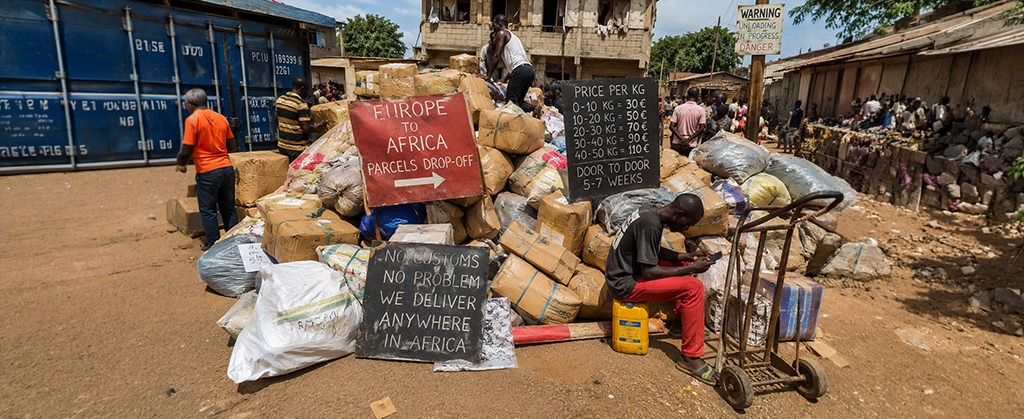
Side Note: Local Shipping Networks
In many countries – especially across Africa – you’ll quickly hear about local shipping networks used by expats and long-term travelers.
These companies often consolidate shipments from Europe and charge by weight, making them significantly cheaper than DHL Express. In many cases, customs procedures also seem less complicated.
Can you use them? Absolutely.
For clothing, camping gear or other non-essential items, they may be a perfectly reasonable option.
Would we use them for critical shipments? No.
After years of traveling, we’ve deliberately stopped using these services for anything our journey depends on – especially vehicle spare parts.
The reasons are simple:
Limited or no tracking
Little transparency
Unclear responsibilities
No global support network
Often no one clearly accountable if something goes wrong
Many travelers will tell you they’ve never had a problem. That’s great – and we genuinely hope it stays that way.
But we’ve learned that it’s not the successful shipments that matter – it’s how a company performs when something goes wrong.
For us, transparency, reliable tracking and clear responsibilities are worth paying for.
As the saying goes:
If you buy cheap, you may end up buying twice.
That’s exactly why we prefer DHL Express whenever the shipment is important enough, that a delay, loss or damaged parcel could jeopardize our travels.

One Final Thoughts
We know this probably sounds overwhelming.
Following all of these recommendations takes time, attention to detail and sometimes quite a bit of patience. It can even feel frustrating when all you want to do is simply get a package on its way.
But speaking from experience, every extra minute you invest before shipping can save you hours – or even days and weeks later. It can also save you money, unnecessary stress and countless emails or phone calls with customs or DHL.
We’ve learned many of these lessons the hard way. Sometimes it was simply a lack of experience. Other times, if we’re honest, we were just too lazy or rushed to double-check the details. More than once, we ended up paying the price and later asked ourselves why we hadn’t spent just ten more minutes preparing the shipment properly.
Better safe than sorry.
That’s probably the single best piece of advice we can give, after years of shipping parcels all over the world.
Good Luck
Cheers,
Totti & Fenny
Last and least: Check out our “DHL Express Shipping Tutorial – Step-by-Step Guide“
FAQ – Frequently Asked Questions
How fast is DHL Express?
DHL Express is one of the fastest international courier services available. Depending on the destination, most international shipments arrive within 1 to 5 business days.
However, the actual delivery time depends not only on DHL Express, but also on how well the shipment is prepared. Accurate shipping documents, precise customs declarations and keeping the number of different items to a minimum can significantly speed up customs clearance.
We’ve experienced both extremes ourselves.
A small parcel containing just a few spare parts was shipped from Germany to Agadir, Morocco, and arrived in less than 24 hours.
On the other hand, a shipment to Saudi Arabia took 31 days. The delay wasn’t caused by DHL Express, but by circumstances beyond our control after the parcel had reached the destination country.
No matter how well you prepare your shipment, customs authorities ultimately decide how quickly it is processed. If officials require additional documents, carry out an inspection or simply don’t know how to handle a particular shipment, a parcel can remain in customs for days—or even weeks.
The good news is that proper preparation greatly reduces the risk of unnecessary delays, even though it can never eliminate them completely.
Does DHL Express deliver on weekends?
It depends on the destination country.
In many countries, DHL Express delivers Monday through Friday, while Saturday delivery is available only in selected locations and may involve an additional charge. Sunday delivery is uncommon and generally not offered.
If your shipment is urgent, don’t assume weekend delivery is available. Check the destination country’s DHL Express services before shipping.
From our experience, the difference is usually negligible. Even if a shipment arrives at the destination over the weekend, it will often remain at the local DHL facility until the next working day—especially if customs clearance is still pending. For international shipments, customs processing almost always has a greater impact on delivery time than whether DHL delivers on a Saturday.
Can someone else receive my package?
Yes, in many countries someone else can receive your DHL Express shipment, but the exact rules depend on the destination country and the type of shipment.
If the parcel is delivered to a private address, another person at that address is often allowed to sign for it.
If you’re traveling, we strongly recommend shipping to a DHL Service Point whenever possible. In our experience, this is the safest and most reliable option. However, the parcel is usually released only to the named recipient, who must present a valid passport or other government-issued photo ID.
If you know in advance that someone else needs to collect your shipment, contact the local DHL Express office before delivery. Some countries allow authorization, while others require the recipient to appear in person.
Our advice: Always assume that only the person named as the receiver can collect the shipment. If someone else is expected to receive it, clarify the procedure with the local DHL Express office before the parcel arrives.
Can DHL deliver to a hotel?
Yes. In principle, DHL Express can deliver almost anywhere, as long as the destination has a valid and accessible address.
This includes hotels, campsites, lodges, guesthouses, private homes and businesses. In some regions, particularly outside major cities, DHL may use a trusted local delivery partner for the final part of the journey if there’s no nearby DHL facility.
However, just because DHL can deliver to a hotel doesn’t mean it’s the best option.
Based on our own experience, we no longer ship important parcels to hotels, campsites or lodges. These locations can sometimes be treated as business addresses, which may complicate customs clearance or even result in additional charges if shipping documents have to be amended.
Instead, we almost always ship to a DHL Service Point.
If you’re staying in a very remote area, DHL Express may not deliver directly to your location. In that case, it’s usually better to have the shipment sent to the nearest major town or city with a DHL Express office or Service Point and collect it there yourself. This is often faster, more predictable and much easier if customs or delivery questions arise.
Can I ship car parts?
Absolutely. DHL Express ships vehicle spare parts every day, and we’ve done so many times while traveling around the world.
Items such as alternators, starters, sensors, brake components, filters, bearings and many other replacement parts can usually be shipped without any problems.
However, accurate customs declarations are essential. Describe every part as precisely as possible, declare a realistic value and make it clear that the parts are intended for repairing your own vehicle, not for resale.
One important thing to keep in mind: Some countries have strict regulations regarding used vehicle parts. In certain destinations, importing second-hand spare parts is restricted or even prohibited. Others only allow them if they’re thoroughly cleaned and free of grease, oil and dirt for environmental or biosecurity reasons.
Before shipping used parts, always check the import regulations of the destination country. A few minutes of research can save you from having your shipment delayed, rejected or even confiscated by customs.
Does DHL Express clear customs?
Yes – but with an important distinction.
DHL Express handles the customs clearance process, submits the required paperwork and communicates with customs authorities on your behalf. This is one of the major advantages of using DHL Express compared to many standard shipping services.
However, DHL does not make customs decisions.
Whether a shipment is approved, inspected, delayed or charged import duties is entirely up to the customs authorities of the destination country.
If customs requires additional documents or information, DHL Express will usually contact the sender or recipient and help facilitate the process. However, it’s still your responsibility to provide accurate information and any requested documentation.
In our experience, DHL Express does a good job of guiding shipments through customs. Nevertheless, if local customs are slow, highly bureaucratic or simply overwhelmed – as can happen in some countries – there is very little DHL can do to speed up the process.
That’s why proper preparation before shipping is so important. Accurate customs declarations, realistic values and complete documentation are the best way to avoid unnecessary delays.
What happens if import taxes are not paid?
If the required import duties, VAT or customs fees are not paid, your shipment will not be released by customs.
In most cases, DHL Express will contact the recipient and request payment before delivery. Depending on the destination country, payment may be made online, by bank transfer or directly to the delivery driver.
If the fees remain unpaid, several things can happen:
- The shipment may remain in customs for a limited period.
- Storage charges may be added.
- The parcel may be returned to the sender.
- In some countries, the shipment may eventually be abandoned or even destroyed if it isn’t claimed within the legal deadline.
Who pays the import charges depends on the shipping terms selected when the shipment is created. In most cases, the recipient is responsible, unless the sender has chosen to pay all duties and taxes in advance.
One important lesson we’ve learned: Don’t assume the recipient will automatically be notified. If you’re waiting for an important shipment, monitor the tracking regularly and stay in contact with the recipient. In some countries, customs or DHL may wait for the recipient to take action, and every day of delay can lead to additional storage fees or other complications.
What are dangerous goods?
Dangerous goods are items that may pose a risk to people, aircraft or the environment during transport. Because DHL Express mainly uses air transport, these items are subject to strict international regulations.
Common examples include:
- Lithium-Ion batteries
- Lithium Metal batteries
- Power banks
- Fuel, diesel and petrol
- Engine oil, transmission oil and hydraulic oil
- Brake fluid and coolant
- Paint, paint thinners and solvents
- Aerosol cans
- Gas cartridges and compressed gases
- Adhesives and certain types of glue
- Fire extinguishers
- Fireworks and explosives
- Matches and lighters
- Chemicals and cleaning agents
- Corrosive substances (e.g. battery acid)
- Flammable liquids
- Flammable solids
- Certain medical and laboratory materials
Some items cannot be shipped at all, while others can only be transported under special conditions, with certified packaging and additional documentation.
If you’re shipping vehicle spare parts, pay particular attention to components that contain oil, fuel or batteries. For example, a used engine component that still contains oil may be classified as dangerous goods, even if it appears to be empty.
When in doubt, ask DHL Express before shipping. It’s much easier to clarify the requirements beforehand than to have your shipment rejected or delayed after it has already entered the network.
Fun fact: In Saudi Arabia for instance, even supermarket flyers showing women in underwear will be classified as pornographic material. What seems perfectly normal in one country, may be prohibited in another – always check local import regulations.
Is my parcel insured?
Yes. DHL Express shipments are generally insured up to €500 at no additional cost (subject to DHL’s terms and conditions and the applicable country-specific rules).
If the value of your shipment exceeds that amount, you can purchase additional Shipment Value Protection to insure the parcel for its full declared value.
Keep in mind that insurance may not apply if the shipment was poorly packaged, incorrectly declared or contains prohibited items. That’s why we strongly recommend using sturdy packaging, keeping all invoices and shipping documents and photographing every item before packing. If you ever need to file a claim, this documentation can be invaluable.
What Was Your Most Frustrating - Yet Funniest- Shipment?
Without a doubt, it was our shipment of vehicle spare parts to Saudi Arabia.
The package contained brakes, an alternator and several smaller replacement parts that we urgently needed for our Sprinter. DHL Express transported it from Germany to Saudi Arabia in just a few days. Everything went exactly as expected—until it reached customs.
Then the nightmare began.
The parcel sat in Riyadh for what felt like forever, without any updates from DHL. When we finally called customer support, we were told the package had been damaged and was already on its way back to Germany.
Panic.
We immediately called a friend in Riyadh and asked him to intercept the shipment. While he was driving to one DHL facility, the parcel had already been transferred to another. It was literally being driven back and forth across Riyadh, making it impossible to catch.
Eventually, the shipment was forwarded to Jeddah, where it was already being prepared for its return flight to Germany.
We jumped into a car with a friend and spent hours driving from one DHL facility to the next until, after several failed attempts, we finally found the parcel.
The whole ordeal had already cost us almost €400 in shipping fees, delayed our journey by more than 30 days, and caused plenty of sleepless nights.
And the best part?
The parcel wasn’t damaged at all.
Apart from a few scratches and dents on the cardboard box, everything inside was in perfect condition.
Looking back, it’s a funny story. At the time, however, it definitely wasn’t.
Sometimes international shipping is an adventure in itself.


This is a really balanced review of DHL Express. People often expect perfection from logistics companies without realizing how much prep work falls on the sender. You hit the nail on the head regarding customs documents and incomplete addresses—those mistakes cause the vast majority of avoidable delays. In international shipping, paying a bit extra for reliability is usually worth every penny when critical spare parts are on the line. Thanks for sharing such practical tips to streamline the process!
Reading your Jeddah story made me laugh in recognition — I have also driven across a city chasing a parcel that tracking said was damaged when the box was barely scratched. Your tip about phoning rather than trusting the status is spot on. At home in the UK I had a smaller version of the same thing on a Sunday: I was waiting in for a spare part, convinced nothing moves at the weekend, until a friend sent me the page explaining Evri deliver on Sunday and the courier knocked that same Sunday morning. Since then I do exactly what you recommend here — check the weekend and local network details before I panic, photograph everything, and keep the documents twice over.
oh my… it’s always the same stories all around the planet, hahahaha.
I do not need theses stresses. Travelin itself is exhausting enough 😉