
When Options Run Out
The Decision to Ship
We never wanted to ship our vehicle. In fact, we had sworn we never would.
From Europe, most destinations can be reached overland and if one route doesn’t work, there is usually another. We have always travelled that way: there is always a Plan B and if necessary – a Plan C.
But we had also heard far too many horror stories about vehicle shipping. Friends and acquaintances told us what had happened to their vehicles and we read countless reports from people describing their experiences: vehicles broken into, windows smashed, interiors completely emptied and everything stolen. Some even reported people sleeping inside their vehicles – or worse, defecating inside and leaving the entire vehicle in a state of utter destruction.
Even the shipping agents we spoke to confirmed that these were not isolated incidents. One well-known German agency told us that break-in rates for RoRo (Roll-on/Roll-off) shipping could reach as high as 85%. WTF?
So we were absolutely certain: we would never ship our vehicle, at least not for a longer period and not RoRO – but eventually, you reach a point where there are no options left.
We were in Africa and wanted to continue to Mongolia, travelling through China and eventually into Southeast Asia. The plan sounded straightforward and – at least on paper – almost perfect:
Mombasa → Oman → Turkey → Silk Road → Mongolia → Southeast Asia.
Then the war involving Iran, Israel and the United States broke out. Fuel prices soared and suddenly our planned five-day sea crossing from Mombasa to Oman was going to cost €10,900.
Going back through the western route across Africa was not an option for us.
So, reluctantly, we made a decision we had spent years trying to avoid:
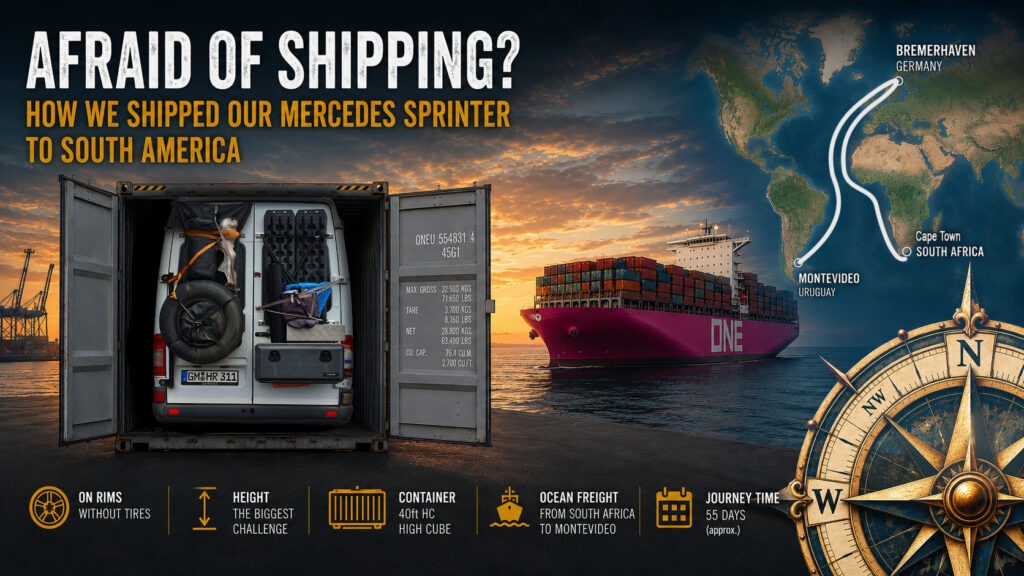
We would ship the Sprinter after all – to South America.
And that was, when the whole spectacle we had been so afraid of, finally began.
Choosing the Right Way to Ship
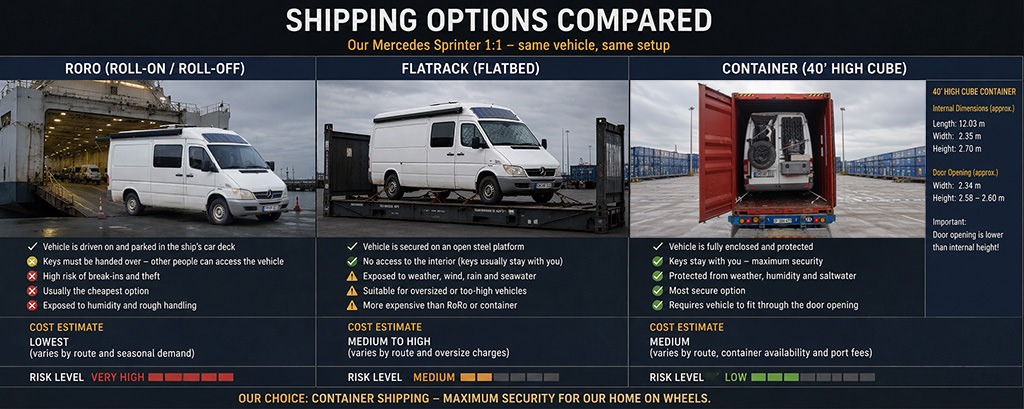
By the time we had made peace with the idea of shipping our Sprinter, we had also made one thing very clear: RoRo was absolutely out of the question. Not because it was necessarily the worst or most expensive option, but because we simply didn’t like the idea of handing over our vehicle and its keys.
With RoRo shipping the vehicle is driven onto the ship and parked inside the vehicle deck. The keys have to be handed over and from that moment on, other people can potentially access the vehicle. Depending on the port and shipping process there can be numerous people involved in handling, moving and loading the vehicles. After everything we had heard about vehicles being broken into and emptied during transport, this was simply not something we were willing to accept.
A flat rack wasn’t really an option for us either. The vehicle is secured to an open steel platform which is then loaded onto the ship. This is a common solution for oversized vehicles, that don’t fit into a standard container. It eliminates the problem of getting the vehicle through a container door, but comes with its own disadvantages: the vehicle is completely exposed to weather and seawater and the cost can be considerably higher.
For us the logical choice was therefore a 40-foot High Cube container. A standard 40-foot container has an internal height of only around 2.39 metres so our 2.75-metre Sprinter was obviously far too tall. A 40-foot High Cube gives you roughly 2.70 metres of internal height and is therefore much closer to what we needed. But there was a catch: the door opening is lower than the internal height. Depending on the exact container, the door opening is only around 2.58–2.60 metres high.
That was the problem.
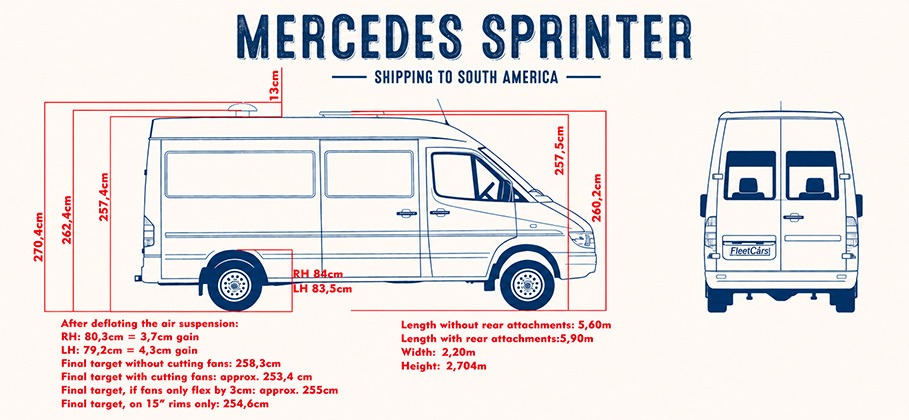
We measured the Sprinter. Then we measured it again. With the roof vent. Without the roof vent. With partially deflated tyres. With the suspension compressed. We even considered the ridiculous idea of putting it on wooden wheels to gain a few centimetres.
Every measurement told us essentially the same thing: we could gain only a few millimetres to centimetres.
Eventually we realised, that the roof hatch would have to be lowered and the roof fan removed completely. All that work just to gain those final centimetres and get through the container door. Once inside the container, there was actually enough room. The real obstacle woule be the doorway.
It would be a ridiculous amount of effort for a few centimetres, but we were prepared to do it. You don’t ship your home on wheels very often and considering what we were planning to do afterwards, this was one of those occasions where the effort seemed justified.
Anything would have been better than driving all the way back through Africa to Europe.
At that point the exact cost was almost irrelevant. We already knew, that the different shipping methods and routes could vary by several thousand Euros. First we had to solve the much more fundamental problem:
How do you get a 2.70-metre-high Sprinter through a roughly 2.60-metre-high door?
Choosing the Right Shipping Agent
Technically, you can arrange an international vehicle shipment yourself. You can contact the shipping line directly, book the container, deal with the port authorities, customs, export and import documentation, insurance and all the other paperwork involved. You may also have to deal with a CDP (Carnet de Passages) or other customs requirements, depending on the countries involved. In theory, this can save money. In practice, however, it can become complicated very quickly, especially if you are doing it for the first time. A good shipping agent knows the procedures, the required documents and the people at the relevant ports and customs authorities. They can coordinate the different steps and, ideally, prevent expensive mistakes.
The problem is finding the right agent.
The right shipping agent is absolutely essential
We started looking in Mombasa because Kenya was supposed to be the final destination of our African journey. We contacted pretty much everyone who had a name in the business. Without going into the details of every conversation, it became increasingly clear, that we did not want to ship from Mombasa.
The quotes were difficult to understand, costs appeared to be hidden behind layers of unfamiliar terminology and every answer seemed to lead to another question. There was a constant back and forth without ever getting a really clear picture of what we would actually pay or what exactly was included. Then came the part that really made us question the whole thing: we were told, that even if we used a container, everything of value had to be removed from the vehicle before shipping.
That raised a very simple question for us: Why would I spend several thousand euros on a secure container if the vehicle has to be emptied anyway because apparently nothing inside it is considered safe?
At that point, the whole concept started to make less and less sense. We also noticed, that the prices had reached a level, where it became increasingly obvious who wanted to have their share of the cake. The actual shipping cost was only one part of the equation. Suddenly there were handling fees, documentation fees, port charges, customs fees and various other additions that were difficult to understand and even harder to compare between agents.
The prices quoted by five different agents varied by thousands of euros.
That seemed suspicious to us.
For us, that was a clear red flag. Not necessarily, because every agent was trying to rip us off, but because we had no transparent basis on which to make a sensible decision. We were first-time shippers and we wanted someone who could explain the process clearly, give us a realistic total cost and tell us exactly what will be done and what we were paying for.
Mombasa was therefore off the table.
We drove all the thousands of kilometres back to South Africa. Our last chance to ship the vehicle, before heading back to Europe by road.

One Last Chance – And We Got Lucky
While we were stoically driving hundreds of kilometres every day to make sure we would reach South Africa in August, we were also contacting shipping agents along the way. At the same time, we met other travellers who had exactly the same plan: getting their vehicles to South America. So we teamed up and decided to become “container buddies“.
Sharing a container roughly halves the shipping cost, which makes a considerable difference, when you are talking about several thousand Euros. There are even Facebook and WhatsApp groups, where travellers connect specifically for this purpose.
The results, however, were sobering. With one single exception, none of the agents we contacted ever got back to us. No answer, no quote, nothing.
So suddenly there was only one chance left – and as it turned out, that last chance was a very reliable one.
In our case, it was Duncan from African Overlanders, together with the Facebook group of the same name. From the very beginning, things felt completely different. Of course, he also told us, that we could trust him and that everything would be fine. But unlike many of the others, his communication felt authentic and relaxed, rather than like a sales pitch. His information was credible, understandable and transparent enough for us to make a decision without constantly wondering, what was hidden somewhere in the small print.
He also offered to have special steel shipping rims made for our Sprinter, so that we could lower the vehicle enough, to get it into the High Cube container. Naturally, that came at an additional cost. But by then we had learned one simple rule: nothing in this world is free. If the solution worked and saved us from much more complicated alternatives, we were happy to pay for it.
You could also tell that Duncan had been doing this for a long time. He knew the business, understood the problems and – importantly – still communicated in a way, that felt straightforward and professional.
Let’s just say he hadn’t become completely africanized yet – if you know what I mean😉
Another major advantage was, that he had plenty of space on his property, where we could camp while preparing the Sprinter for South America. He also runs a workshop with some very capable and resourceful mechanics, which turned out to be extremely useful, considering what we still had to do to the vehicle before it should go into the container.
And then there was the price. It wasn’t cheap, but it was perfectly reasonable, considering the circumstances and the fuel prices at the time. After everything we had seen and heard in Mombasa, we finally had the feeling, that we were dealing with someone, who was offering us a realistic solution, rather than simply trying to make as much money as possible from our predicament.
We had found our shipping agent.

Everything “Half So Wild”
At some point we decided, that this whole shipping business was getting far too much attention. We had made our decision, found our agent and there was no point in worrying about the process every single day. So we simply stopped thinking about it and concentrated on the things we could actually control: getting the vehicle ready and planning what we were going to do, during the roughly two-month waiting period. Flying back to Germany and sitting around there for two months was never an option for us, so we needed other destinations, flights, rental cars and accommodation, to bridge the gap until Rossi would eventually arrive in South America.
We also quickly realised how simple the whole process can actually be, when you get clear information and straight answers to straight questions instead of being buried under vague terminology and crazy shipping jargon. In principle, the entire process is pretty easy if you have the right agent. A good one takes care of everything, that needs to be done and I have to say: Duncan is a man who has seen it all. Flexible… very flexible… iykwim.
That gave us a tremendous amount of security and freedom. Our fear of shipping disappeared almost overnight.
Meanwhile, we spent almost an entire month working on Rossi practically every single day, preparing him for his next chapter in South America. Montevideo was the destination and – more importantly – the place where our new journey would begin. There was plenty to do, from removing, reparing and modifying things to finding solutions for the container dimensions in case, there were no similar rims for our van, which could be altered to fit.
Duncan’s property gave us a pretty good idea of just how much experience he had with this business. There were dozens of travel vehicles scattered around the place, either waiting to be shipped or waiting to be collected by their owners. For us, this was actually quite reassuring. This wasn’t some guy, arranging the occasional vehicle shipment.
He was dealing with this kind of thing all the time.
The only thing we had to keep reminding him about from time to time, was our Container Rims. They still had to be manufactured specifically for Rossi. That was pretty much the extent of our shipping-related stress. We left the rest to Duncan and got on with our lives.
The Day Had Finally Come
Duncan had ordered the containers and had them delivered directly to his property, where they were parked in front of the loading ramp together with the truck. Our custom container rims had been finished for quite some time and fitted the Sprinter perfectly on the first attempt. Even so, our loading process was considerably more complicated, than that of our container buddies, who simply drove their vehicles straight into the container. Their loading time: about 2 minutes.
For us, it took almost two hours. We had to jack the Sprinter up and down in several stages, until it was finally sitting on its special container rims. The loading ramp itself was far from level and there was also a height difference of around 10–15 cm between the ramp and the container entrance. I simply didn’t trust myself to drive the Sprinter across that uneven transition and into the container. That job was taken over by Dany, the head mechanic.
In total, between five and seven people were involved in getting the Sprinter into the container. It was precision work. Even though the new rims had gained us 16.5 centimetres in height and should have left us with around four centimetres of clearance, the uneven transition between the loading ramp and the container entrance made things considerably more difficult. In the end, there really were only a few millimetres of clearance.
Everyone worked with incredible precision and care. Duncan kept the entire operation under control, constantly checking everything and giving instructions. One of the helpers was actually lying on top of the container, carefully checking the clearance as the Sprinter moved forward. Once the vehicle was finally in position, everything was securely strapped (the so called “lashing”) down. Our original wheels were secured as well. The container was closed, locked and sealed and after roughly two hours the truck finally drove away with Rossi safely inside.
I have to admit, that I did have a bit of sweat on my forehead towards the end. Looking at that tiny gap between the roof and the container entrance was one thing. Watching our home on wheels being slowly pushed into it was something else entirely. But in the end, all’s well that ends well.
Now there is only one question left: Will we actually get Rossi out of that container again?
That part is no longer in Duncan’s hands. The unloading operation in Montevideo will be handled by the local staff there. But at least we can relax a little: we took out a new insurance policy that covers any damage that might occur during the entire process until we are finally sitting behind the wheel again.
Bye, bye Mr. Rossi – See us in Uruguay
Let’s Talk About the Preparation
For shipping a vehicle out of South Africa, you need the appropriate customs documentation, usually either a Carnet de Passages en Douane (CPD) or a Temporary Import Permit (TIP), depending on the circumstances and the destination. We already had a Carnet.
We handed it to Duncan before the vehicle was loaded and he took care of the necessary customs procedure. Once the Sprinter was in the container, he handed the stamped Carnet straight back to us. We could then send it back to the issuing organisation because, as far as our South American destinations were concerned, we didn’t need it anymore. That was the paperwork. Job done.
The vehicle itself was a completely different story. Apart from all the repairs and maintenance you might want to do before shipping a vehicle overseas, you should also think carefully about the destination.
Is the vehicle actually ready for the new environment? Are the diesel filters suitable? Do the operating fluids need to be changed? Is there any special equipment you should have on board? Are there spare parts or other items, that should be ordered and installed before the vehicle disappears into a container for several weeks? All of this takes time.
Fortunately, we had arrived at Duncan’s place almost a month before the container was due to leave, instead of the 7 to 14 days, we had originally planned. We ended up needing practically every single one of those days and even then things got tight.
Then there was cleanliness and hygiene.
We cleaned Rossi almost obsessively, because the last thing we wanted, was to send a few thousand uninvited passengers to South America in the form of ants, insects or other unwanted creatures. We used up our food supplies wherever possible. Anything that couldn’t reasonably be opened or emptied was left inside the van. The water tanks were emptied several days before loading and the hoses were blown out thoroughly. The objective was simple: eliminate as much moisture as possible and leave nothing behind, that could encourage mould or unpleasant smells during the voyage.
The gas bottles needed to be emptied… or not? 😉
And there is one thing that really matters: everything has to be completely dry. Even slightly damp clothing or other organic material can become a serious mould problem inside a closed container. Mould spores are already present in the air and on fabrics. Once you combine moisture, warmth and several weeks without proper ventilation, you have almost perfect conditions for fungal growth. What starts as a little residual dampness, can therefore turn into a very unpleasant surprise by the time you open the container again.
This would have been particularly difficult in Mombasa. With temperatures around 35°C and humidity approaching 98%, getting everything genuinely dry would have been a challenge in itself. At Duncan’s place this wasn’t an issue. The climate was much more suitable and we had enough time to make sure, everything was properly dry before loading.
A few days before the container arrived, we also started thinking about humidity inside the container. We bought conventional moisture absorbers from a hardware store and placed six of them inside Rossi. Duncan added another two in the driver’s cab and strongly recommended leaving the windows wide open during the sea voyage. The idea is to allow moisture to escape rather than trapping humid air inside the vehicle. A container is not an airtight environment, but ventilation and moisture control can still make a significant difference over a long voyage.
One small detail is easy to overlook, but can become very expensive: leave the vehicle key inside the vehicle. It might seem obvious to take it with you, but there are situations, where port staff may need to move the vehicle for inspection, loading or unloading. If the vehicle has to be removed from the container for some unexpected reason and nobody has the key, a perfectly avoidable problem can suddenly become an expensive one.
There are a few more things worth checking before closing the container: disconnecting or securing anything that could move during transport, checking that all external equipment is firmly attached, folding in the mirrors if necessary, securing cupboards and drawers inside the vehicle and making sure nothing can fall or leak. Gas cylinders and other regulated items also need to be dealt with, according to the shipping line’s requirements.
Last and least: disconnceted the batteries and all electric devices. (LifePO4 batteries are a nobrainer, btw *pssst*🤫)
Also, don’t forget to take all the things and clothes you’ll need for your onward journey with you. We packed our suitcases two days in advance because how often do you forget something that you desperately need later?
Finally, take photographs of the vehicle before it disappears into the container. Photograph the exterior from every angle, the interior, the dashboard and anything else, that could later be relevant for an insurance claim.
The general rule is simple: prepare the vehicle as if nobody will be able to touch it for the next two months. Because, essentially, that’s exactly what is going to happen.
… and in the Meanwhile?
Now comes the part where the sweating starts.
Where is our container? Which route is the ship taking? Where will it call next?
Fortunately, you don’t have to sit there completely in the dark. You can actually track the ship and, depending on the service, even the container.
VesselFinder.com offers both ship and container tracking. The free version is perfectly sufficient for our purposes and can even be integrated into your own website. With the map and the vessel’s schedule, you can keep an eye on where your container is and where it is expected to be next.
Of course, it would be nice to travel with your vehicle throughout the entire journey, but honestly: who wants to spend almost two months sitting on a container ship?
Many travellers simply fly back to their home country and wait it out. That wasn’t particularly attractive to us. There was nothing waiting for us in Germany, so instead we started looking for places, that were affordable to reach and inexpensive to live in.
At the same time, we deliberately looked for destinations that would be more difficult or expensive to explore with our own vehicle.
For us, the basic requirements were pretty simple: good climate, interesting destinations and reasonable costs. That led us to Indonesia and Malaysia.
A direct flight from Cape Town to Jakarta or Denpasar would have been considerably more expensive, so we split the journey into two separate flights: Cape Town → Singapore → Jakarta. That little detour saved us around €900 on the outbound journey.
We spent five days in Singapore and then a month in Indonesia (where we are right now).
Malaysia will be later squeezed into the itinerary, because Indonesia only allows us to stay for one month under our particular circumstances and requires proof of onward travel.
The final onward flight is something, we deliberately decided not to book yet. Malaysia also wants to see an onward ticket, but we wanted to wait until Rossi had actually left Bremerhaven and was safely on his way directly to Uruguay. At that point, we would finally know, that our vehicle was moving in the right direction and could plan the final leg of our own journey with much more certainty.
And this is where our two journeys really start to look rather different.
Rossi’s route:
Cape Town → Algeciras → UK → Bremerhaven → Montevideo
Our route:
Cape Town → Singapore → Jakarta → Kuala Lumpur → Montevideo
Two completely different routes, one common destination. While Rossi was crossing oceans and changing ships, we were hopping from one country to the next and trying to make the two-month gap as interesting as possible.

Chapter One – Over and Out
And that’s where Chapter One ends.
For now, we’re simply going to wait, keep travelling and see what happens. Rossi is on his way and there isn’t much more we can do from here, except follow his progress and hope that everything goes according to plan.
We’ll tell you all about Chapter Two once we’ve actually got Rossi out of the container in Montevideo and are sitting behind the wheel again.
Until then: Stay tuned, stay safe.
Cheers,
Totti & Fenny
FAQ – Frequently Asked Questions
How much does it cost to ship a campervan from South Africa to South America?
For our Mercedes Sprinter, we paid USD 5,000 for the shipping itself, covering both ends: USD 3,800 to African Overlanders and another USD 1,200 to the agent in Montevideo. There will naturally be a few additional costs here and there, so realistically it’s USD 5,000 plus a little extra rather than less.
That said, this is generally considered quite expensive. We were told that the current circumstances and the departure and destination countries have a significant impact on the price. Uruguay apparently has some of the highest vehicle shipping costs in the region, which was one of the reasons our total came out higher than we initially expected.
How do you pay for the shipping?
This entirely depends on the payment options offered by your shipping agent. We would have preferred to pay by PayPal but that wasn’t possible in our case, so we made an international bank transfer instead. This cost us an additional €20 in bank fees.
Other agents may offer different payment methods, so it’s worth asking about this before booking.
One important point: our agent in South Africa required payment in USD and we were told that USD would also be required for the agent in Montevideo. Make sure you clarify the required currency and payment method in advance, especially if you are dealing with international bank transfers and potentially significant amounts.
How were the container rims made and how much did they cost?
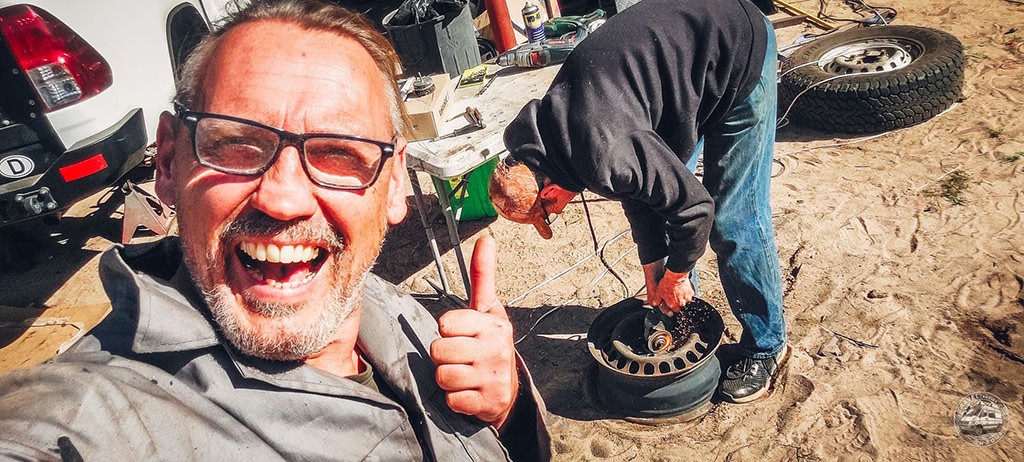
Duncan found suitable used rims at a scrapyard that were close to the specifications of our original wheels. We provided the required wheel size and offset (ET) and his mechanic then modified the rims by hand to fit the Sprinter. The modification essentially involved drilling five new mounting holes and enlarging the centre bore with a small angle grinder.
The total cost was USD 200 for the set. However, if you have the tools and some basic mechanical skills, you can easily make these rims yourself and save the money. Essentially, you only need suitable rims, the correct dimensions, five new mounting holes and a way to enlarge the centre bore accurately.
What About Gas Cylinders and Lithium Batteries?
Officially, both gas cylinders and lithium batteries are considered dangerous goods by shipping companies and can be subject to strict regulations. We had read that gas cylinders may require a certificate confirming that they are completely empty and that lithium batteries may not be allowed to travel with the vehicle at all.
In our case, neither was an issue. Our gas cylinders were already empty and nobody was particularly interested in the two lithium batteries we had installed in Rossi. In Mombasa, however, we had been quoted USD 400 just for shipping the lithium batteries. In Cape Town, nobody charged us anything for them.
So they simply stayed where they were and nobody asked any questions.
If you run into a problem with your lithium batteries, you could always get creative and label them as AGM batteries… 😉
But be careful: we have no idea how such a workaround would affect your insurance coverage. We certainly wouldn’t want to give anyone the impression that this is an officially approved solution.
Did Customs want to inspect the Van?
No. Duncan handled everything for us. There was no customs inspection with us present and there wasn’t one without us either. As far as we were concerned, the entire customs procedure was handled smoothly and without any inspection of Rossi.
Things might have been different in Mombasa. We had already been told, that customs officers there were also known to have rather sticky fingers from time to time. Whether that’s actually true, we simply don’t know. We can only say, that we had heard it from several agents.
Can you be present during container loading?
Yes, of course. You can be there for the entire loading process and have virtually full control over what is being done to your vehicle. We definitely wanted to be present, partly for security reasons but also because, quite honestly, we found the whole process fascinating. We wanted to see with our own eyes, how Rossi would actually get into that container.
Other travellers chose a different approach. They simply handed their vehicles over to Duncan and let him manage the entire process himself. Given his experience and the team he works with, that is also a perfectly viable option.
How Much Time Do You Have to Load the Container?
Generally, as much time as you need – or as much time as the team needs. There is no rushing and nobody is pushing you, to get the job done as quickly as possible. The container is delivered to Duncan’s property and can stay there for as long as necessary. If it takes an entire day, then it takes an entire day (but shouldn’t)
We needed around 2 hours to get Rossi safely into the container. Everything was done calmly, carefully and with precision. Given how tight the clearance was, we were very happy that nobody was in a hurry.
We do not know about Montevideo though, but we will update this information, once we know.
How far in advance should you book the shipment?
All the agents we spoke to, recommended booking roughly 4–6 weeks in advance. The earlier you book, the less precise the pricing tends to be, as shipping rates can change and the final costs are usually confirmed only a few days before departure.
We announced our shipment about 6 weeks in advance and made the booking final 4 weeks before departure. This gave us enough time to prepare Rossi properly, while still allowing the agent to provide us with a reasonably accurate final price.
How do you find a reliable shipping agent?
Talk to other travellers. Check Facebook, Instagram, Blogs, YouTube and WhatsApp groups and see, what other overlanders have experienced with different agents. Many shipping agents have also built a reputation on iOverlander – some good, some bad. In the end, there is no perfect formula for finding the right one. Do your research, compare the information you get and then trust your gut feeling.
What should you ask a shipping agent before booking?
Ask everything you can think of and make sure you get clear answers rather than a cloud of shipping terminology. At the very least, ask what is included in the quoted price, what additional costs might occur, which documents are required, what exactly you are allowed to leave inside the vehicle and what has to be removed.
You should also clarify who handles customs at both ends, whether the vehicle will be inspected, who is responsible for loading and unloading, how long the container can remain at the loading location and what happens if the ship is delayed. Ask about insurance, the exact container dimensions and especially the door opening height if your vehicle is anywhere near the limit.
Personally, I pay very close attention to how my initial questions are answered. Some people somehow manage to answer only one question when you have asked five. I often make a point of saying: I’m a complete beginner. Explain it to me like I’m a five-year-old. If I immediately understand the answer and all my questions are actually addressed, that’s already a big step towards building trust.
And most importantly: ask for the complete price in writing. If the answer changes every time you ask another question or you still don’t understand what you are actually paying for, that’s probably a good time to look for another agent.
What insurance did you have and how much did it cost?
Since we can’t really judge an insurance policy before or after the fact – the real test only comes when you actually have a claim – we don’t want to name the insurance company.
What we can say is, that we took out something comparable to comprehensive insurance for the entire shipping process. The premium was €450.
The policy covers damage, that can occur in connection with the shipment, including damage during loading and unloading, handling at the port, transport inside the container and the actual sea voyage.
It also covers damage caused by accidents, mishandling or other incidents occurring while the vehicle is under the responsibility of the shipping process. In our case, the cover remains in place until we are back behind the wheel of Rossi in Montevideo.
For us, that was an important point. The vehicle is our home and contains considerably more than just a vehicle’s worth of equipment. For €450, we considered the additional peace of mind well worth it. But whether the insurance is actually as good as it sounds, is something we will hopefully never find out.
Does the vehicle has to be registered and insured?
No, it doesn’t – and ours isn’t.
The vehicle does not have to be currently registered or have a valid road insurance policy in order to be shipped.
We insured Rossi and everything inside him for a total value of €50,000. To document the contents properly, we took photographs of every individual item. The insurance company itself only required photographs of the vehicle from the outside along with the relevant vehicle documents, as well as an approximate timeframe.
When declaring the insured value, however, you should use some common sense. Don’t deliberately set the value excessively high, as the insurance company may decide to investigate and request additional documentation. But don’t underestimate the value either, because in the event of a claim you want the insured amount to actually reflect, what you stand to lose. In our case, €50,000 seemed like a realistic figure for the vehicle and its contents.
Is there still something important to know about an insurance?
Oh yes!
There is one thing about marine cargo insurance that many people – including us before we looked into it – probably don’t realise. If the ship suffers a major accident or even sinks, the consequences can go far beyond simply losing your vehicle. Depending on the circumstances, the cargo owners can be required to contribute to the costs of a general average claim. In other words, the financial consequences of a major incident can be shared among the parties whose cargo is being transported.
So, in the highly unlikely event that the ship sinks and you have no appropriate insurance, you could potentially end up with no vehicle, no compensation and an additional bill for your share of the general average costs. That’s not exactly the kind of souvenir, we wanted to bring home from our first shipping experience.
Our insurance included this risk, which was another reason, why we considered the €450 premium money well spent.
Better safe, than sorry, r8?
What are the measurements of a 40" HC (High Cube) Container?
A 40ft High Cube container has the following approximate dimensions:
External Dimensions
- Length: 40 ft (12.19 m)
- Width: 8 ft (2.44 m)
- Height: 9 ft 6 in (2.89 m)
Internal Dimensions
- Length: 39 ft 6 in (12.025 m)
- Width: 7 ft 9 in (2.352 m)
- Height: 8 ft 10 in (2.585 m)
- Capacity: 2,694 cu ft (76 m³)
Keep in mind that these dimensions are not necessarily identical for every container. Depending on the manufacturer and container type, the actual measurements can vary by a few centimetres. This is particularly important when you are dealing with a vehicle that only fits through the container door with a few centimetres to spare.
Always check the exact dimensions of the specific container before shipping your vehicle or make sure, your vehicle definitely will fit!
How do you find a Container-Buddy?
There are several Facebook and WhatsApp groups specifically for travellers looking for someone to share a shipping container. There are also groups dedicated to particular countries or routes. Here are a few examples:
Containersharing WhatsApp Group
WhatsApp Group – Containersharing
Panamericana WhatsApp Group
WhatsApp Group – Panamericana
Panamerican Overlanders WhatsApp Group
WhatsApp Group – Panamerican Overlanders
Container Buddy – Europe ↔ North and South America
Facebook Group – Container Buddy
Some shipping agents and agencies also offer a container-buddy matching service, so it is always worth asking them directly. On popular routes you will usually find someone looking for a shared container, especially if your travel dates line up. Many regions have particular travel seasons, when large numbers of overlanders are heading in the same direction, which makes finding a suitable container buddy considerably easier.
What if you don't find a Container-Buddy?
That happened to us when we originally considered shipping from Mombasa. We were planning to ship at a time of year when hardly anyone was travelling to South America, so there simply wasn’t anyone looking for a shared container. We were therefore prepared to pay for the entire container ourselves and had actually almost gone ahead with it.
Then our agent dropped the bombshell that we would have to remove all valuable belongings from the vehicle anyway and that the available High Cube containers weren’t available in the required length. That was the point where we decided to walk away from Mombasa.
If your vehicle is longer than 6 metres, you may have no choice but to book a container entirely for yourself anyway. And if you’re travelling to an unusual destination or at an unusual time of year and can’t find a container buddy, the whole thing can get expensive very quickly.
So if you are planning to share a container, start looking for your container buddy early. The more flexible you are with dates and routes, the better your chances of finding someone to share the cost.
How do you know, where your container is?
Your shipping agent will provide you with the container number and the name of the ship carrying it. You can then enter the ship’s name into VesselFinder and follow its position throughout the voyage.
Container tracking is a separate service and usually costs a small fee. If your container is transferred between several ships during the journey, container tracking becomes much more useful, because simply following the original ship will no longer tell you, where your container is. In our case, the container tracking option cost roughly €7.
Did you ultimately have to remove all valuable items?
No. Our agent actually laughed when we told him, what we had been told in Mombasa. We were able to leave 100% of our belongings and inventory inside the van.
As far as customs inspections are concerned, our agent explained that customs cannot simply open the container on their own. If customs wants to inspect the contents, the agent has to be notified and be present when the container is opened.
According to our agent, this happens extremely rarely. So in our case, everything stayed inside Rossi exactly where it belonged and we didn’t have to empty our home on wheels before shipping it.
Where did you put the moisture absorbers?
The most important thing is to place the moisture absorbers somewhere where their little collection containers cannot tip over. Once they are full, they can overflow and you definitely don’t want several hundred millilitres of liquid sloshing around inside your campervan.
We therefore took some 5-litre plastic containers, cut them open and placed the moisture absorbers inside them. This gave them a stable base and made sure they couldn’t wobble around or tip over. And if one of the absorbers did tip over, any liquid would simply run into the 5-litre container instead of spilling into the van.
The moisture absorbers themselves were distributed strategically throughout Rossi. We placed them where they couldn’t fly around during transport and also in places where we expected more moisture to accumulate, such as the cupboard containing the water tank. The idea was simply to create several independent moisture traps throughout the vehicle, rather than relying on one or two absorbers in a single location.
We also stood the two mattresses upright and arranged them like a tent, so that they wouldn’t be pressed tightly against each other. Any points where damp mattresses remain in contact for weeks, can become perfect places for mould to develop.
At the rear of Rossi, we placed six moisture absorbers throughout the living area. In the driver’s cab, we added another two, one in each of the footwells. If one of them happened to leak there, it wouldn’t cause any damage, because the liquid would simply collect in the recessed footwell and drain away, through the existing drainage holes, causing no damage.
What additional costs should you expect when shipping your car?
In general, the quotation from your shipping agent should give you a reasonably reliable idea of what the actual shipping will cost. However, there always seem to be additional charges that even the agent cannot predict in advance. These can include customs scanning fees, additional port handling, storage charges, documentation fees or other local charges that, only become apparent once the vehicle reaches the port.
But all of that is still only the cost of getting your vehicle into the container and eventually into the destination country.
You also have to think about your own costs while the vehicle is travelling. Unless you want to spend several weeks sitting at home waiting for your campervan, you will need flights, accommodation and possibly rental cars or other transportation. These costs can quickly become a significant part of the overall bill and should definitely be included when calculating, what the shipping is actually going to cost you.
Of course, this depends entirely on your individual travel plans. In our case, the shipping itself was only part of the equation. With flights, accommodation, rental cars and everything else involved in bridging the waiting period, we estimate, that we will have spent around €10,000–€12,000 in overall expenses, that we wouldn’t normally have had.
That is the real cost of deciding to send your home on wheels halfway around the world, while you travel separately.
Are there alternatives to shipping your own vehicle?
Yes. Shipping your own vehicle is certainly not the only option. The most obvious alternative is to sell your vehicle before leaving and buy another one at the destination. This can make financial sense if you are planning to stay in your desired country for a long time. You avoid shipping costs, port fees, customs procedures and the risk of damage during transport. You can also buy a vehicle that is already adapted to local conditions and spare parts availability.
The downside is that buying a suitable campervan in a foreign country can be difficult. Finding exactly what you want, checking the vehicle’s history and technical condition and dealing with registration and insurance can take considerable time. You also have to sell the vehicle again at the end of your trip. Depending on the country, importing or registering a foreign vehicle can be complicated as well.
Another possibility is to buy a vehicle in a neighbouring country where the market is larger or prices are better, then drive it across the continent. This gives you much more freedom than renting but you still have to deal with ownership, registration, insurance and potentially import restrictions.
Renting a campervan is the simplest solution from an organisational point of view. You arrive, pick up the vehicle and start travelling. There is no shipping, no customs and no long-term commitment. The obvious disadvantage is the price. For a trip lasting several months or years, rental costs can easily exceed the cost of shipping and owning your own vehicle.
You can also travel without a campervan at all, using buses, domestic flights, trains and occasional rental cars. South America has an extensive long-distance bus network and in many regions this can actually be considerably easier than travelling with a large vehicle. The downside is obvious: you lose the freedom and independence that comes with having your own home on wheels.
For us, none of these alternatives really made sense. We had already spent years building and adapting Rossi to exactly the way we travel. Selling him and starting again would have meant giving up something we knew and trusted. Renting for several years would have been enormously expensive and travelling without him simply wasn’t what we wanted to do.
So yes, there are alternatives. But for us, shipping Rossi was ultimately the least complicated solution — even though it was the one we had originally sworn we would never do.
How long will the shipping take from South Africa to South America?
Our shipment is scheduled to take 55 days from South Africa to Montevideo. However, we have heard plenty of stories from other travellers, who ended up waiting up to 3 months for their vehicles to arrive. The reason is, that the advertised transit time is not necessarily the same as the actual time your vehicle spends in the shipping system.
A container ship rarely sails directly from A to B. Depending on the route and the shipping line, it may call at several ports along the way. Containers can be unloaded, transferred to another vessel or simply remain in a port, waiting for the next available connection. Weather, port congestion, customs procedures, technical problems, schedule changes and missed connections can add days or even weeks.
This is particularly relevant when your vehicle is travelling on a route, with several intermediate ports. Even if the actual time at sea is relatively predictable, everything that happens before, between and after the ocean legs, can be much harder to predict.
So if you are planning your own trip around the arrival of your vehicle, don’t book your onward travel too tightly around the scheduled arrival date. Fifty-five days may be the plan. Your vehicle may have a completely different opinion.
How long do you plan to stay in South America?
That depends entirely on the countries, our desire to travel and how we feel along the way. Our current plan is to spend 5 to 6 years exploring South America, but it could just as easily turn into 1 or 2 years.
We don’t really plan this kind of thing too far ahead. We prefer to let ourselves drift, see what happens and let the countries and the people we meet along the way influence, where we go next☺️.


Ohhhh wow!!! Super Job 👏
Thanks for all this inside views, which are really helpful for us right now! We are full power organising right now our first shipment from Malaysia to Australia.
Your blog is gold ✨️ We will copy your idea and put our Van on rims and then Juhuuuuu! in the container 😅😅😅 maybe we also find an container buddy 😄
You really inspired our solution finding-way!!!!
Thank you very much🙏
Yeah, saustark😁 Good to know, that all my writing is good for something.
I’m super curious, how your shipping to Australia will work and:
Good luck, with the wheels, Seb for sure is the right guy to do them for you 🙂
Have safe further travels😍 and hopefully you’ll find a Container-Buddy as well🙏