

Pure shipping costs vs the rest
There are basically two ways of shipping a vehicle overseas.
The first one is pretty simple: you are sitting comfortably at home, your car is sitting somewhere nearby and you decide to send it to another continent.
You hand it over to the shipping company, pay the bill and wait for it to arrive. While your vehicle is crossing the ocean, you are sitting at home, drinking coffee, going to work and sleeping in your own bed. In other words: your life continues as normal while your car is having its little ocean adventure.
The shipping itself has a fairly straightforward cost structure. You have the actual freight, port charges, handling, documentation, customs-related costs, insurance and whatever other fees happen to appear on the final invoice. You add everything up, pay the bill and that’s basically it.
At least as far as your personal costs are concerned.
But then there is the second way of doing it. And that’s the one we’re dealing with.
You are travelling around the world, you don’t have a fixed home anymore, coz your home is basically on its own trip.
So when you hand your beloved home on wheels over to the shipping company, there is one tiny question left: Where do we go now?
Because you obviously can’t climb into the container with the vehicle and sail across the ocean with it. And sitting at the port for several weeks waiting for your vehicle to arrive isn’t particularly appealing either. So while your vehicle is crossing the ocean, you have to somehow get yourself from A to B as well.
And this is where the calculation starts to get far more interesting, than you’d expect.
The shipping company might tell you that getting your vehicle from one continent to another costs €3,000. Great. But those €3,000 only get the vehicle there. You still need flights, somewhere to sleep, possibly a rental car, visas, extra luggage, maybe some additional clothes, fuel for the rental car, transfers, entrance fees and all the other little expenses that tend to appear when you suddenly have to live somewhere else for a few weeks.
Some costs remain roughly the same, of course. We still have to eat, whether our vehicle is sitting in a port or sailing somewhere in the middle of the Atlantic. On the other hand, we don’t use diesel for our own vehicle while it is being shipped, so there is a small saving there.
The problem is that all those additional costs are very easy to overlook when you first look at a shipping quote. A €3,000 freight bill can therefore look like a €3,000 trip – until you actually add everything up. And suddenly the €3,000 has turned into €5,000, then €8,000 and before you know it you are looking at €10,000 to €15,000 for the whole operation.
And that’s exactly what we want to look at here: not just what the shipping company charges for moving the vehicle, but what it really costs to get both the vehicle and ourselves from one continent to the next.
The Raw Shipping Cost – What Determines the Price?
Before we get into all the extra costs, let’s first look at how you can actually ship a vehicle overseas. There are several different options, and they can come with very different pricing structures.
Depending on the vehicle, route and available services, you may be able to ship it in a 20-foot container, a 40-foot High Cube container, on a Flat Rack or via RoRo (Roll-on/Roll-off). Each method has its own advantages, disadvantages and pricing structure.
For this article, however, we are focusing specifically on High Cube container shipping, as that is the method we used for our own vehicle.
And even once you have decided how to ship the vehicle, the actual price isn’t as straightforward as you might think. There is no universal price list where you enter your vehicle and destination and get a fixed number.
The first factor is the route and destination. Shipping from Hamburg to Halifax is a completely different calculation from South Africa to Montevideo. Distance, available shipping routes, port infrastructure, transshipment and demand all influence the price. Some routes have plenty of vessels and capacity, while others are served only occasionally – and that can make a big difference.
Then there is seasonality. Shipping capacity and demand fluctuate throughout the year, just like flights and hotels. When demand is high and space or containers are limited, prices tend to rise. At quieter times, you may find considerably better rates.
And finally, there are things nobody can really plan for: politics and global events. Fuel prices have a direct impact because container ships burn huge amounts of fuel. Wars, sanctions, energy crises, port congestion or disruptions to major shipping routes can push costs up quickly. The Red Sea is a good example: when ships avoid the region and sail around the Cape of Good Hope instead, they travel thousands of additional nautical miles, burn more fuel and take longer.
So even before adding a single hotel or flight, the basic shipping price is already a moving target. The shipping method, destination, season, fuel prices, capacity and world events can all change what you eventually pay.
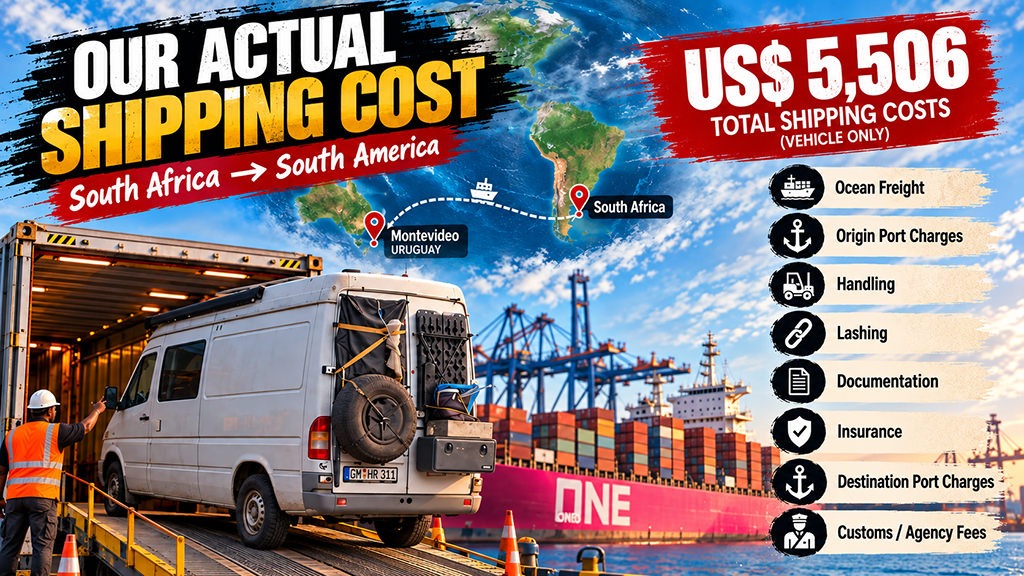
For our own shipment from South Africa to South America, the pure shipping costs came to US$5,000. This included the complete shipping process, including the origin and destination port charges and all the associated fees.
The comprehensive vehicle insurance, costing US$506, had to be taken out separately with another provider.
So US$5,506 was the amount we actually paid to get the vehicle from one continent to the other – before adding all the costs we had because we had to live somewhere and get ourselves there while the vehicle was on the ship.
One thing that should not be forgotten: the US$5,000 price is only for half of a HC container. If you needed the entire container for yourself, you would pay for the whole container, while the other costs would not change significantly.
This price was only possible because we had a so-called container buddy – someone who shares the container with you.

The Additional and Most Uncomfortable Part
This is where things get considerably more tricky. Your vehicle is on the ship for let’s say 55 days (like ours), but you still have to live somewhere during that time. So the question becomes:
Where do you go?
Ideally, you want a country where accommodation and everyday expenses are reasonably cheap. A place where you can find affordable hotels or apartments, eat without spending a fortune and, if necessary, rent a car at a reasonable price. But cost isn’t the only consideration. After all, spending almost two months somewhere purely because it is cheap isn’t particularly appealing. We also wanted a destination with enough to see and do to keep us busy for the entire time, rather than spending six weeks wondering what to do next.
The climate was another important factor. If you are going to spend almost two months in one place, you don’t really want to spend that time dealing with constant rain, extreme heat or whatever other weather conditions make travelling less enjoyable. So the ideal destination had to offer a good combination of reasonable costs, plenty of things to explore and suitable weather.
Then there is the question of how to get there in the first place. The cheapest flight is not necessarily the cheapest overall solution. Depending on the route, combining several flights, different airlines or even different departure and arrival airports can sometimes save a surprising amount of money.
Flexibility can make a huge difference!
So those 55 days require quite a bit of planning. You are essentially building a temporary travel itinerary around the shipping schedule: find the right destination, find affordable accommodation, work out transportation, check the climate and attractions and piece together the cheapest practical flight combination.
And that is where the additional costs really start to add up.
The Iteration of Planning and Calculating
Before we get into the actual process, here is a small tip: it can make a price difference, even if only a small one, which country you use when searching for flights and accommodation on the various platforms. In our case, Germany was around €30 cheaper than using exactly the same platform with Indonesia or Singapore as the selected country. So it is definitely worth trying different country settings before booking anything.
Our planning therefore started with the destination itself. We first looked for countries that matched the climatic conditions we were looking for. Once we had a shortlist, we iteratively checked rental cars, rough everyday living costs and approximate accommodation prices. This allowed us to gradually narrow down the options until we had a country that made sense not only financially but also in terms of the overall conditions.
Once we had settled on a destination, we moved on to the flights. Since we already knew that searching from Germany was cheaper, we used the German version of the search platform. Another useful trick is to look at the major airline hubs first. Which airlines fly regularly from where to where? Once you know the main hubs, you can start combining different routes instead of simply searching for a direct connection from A to B.
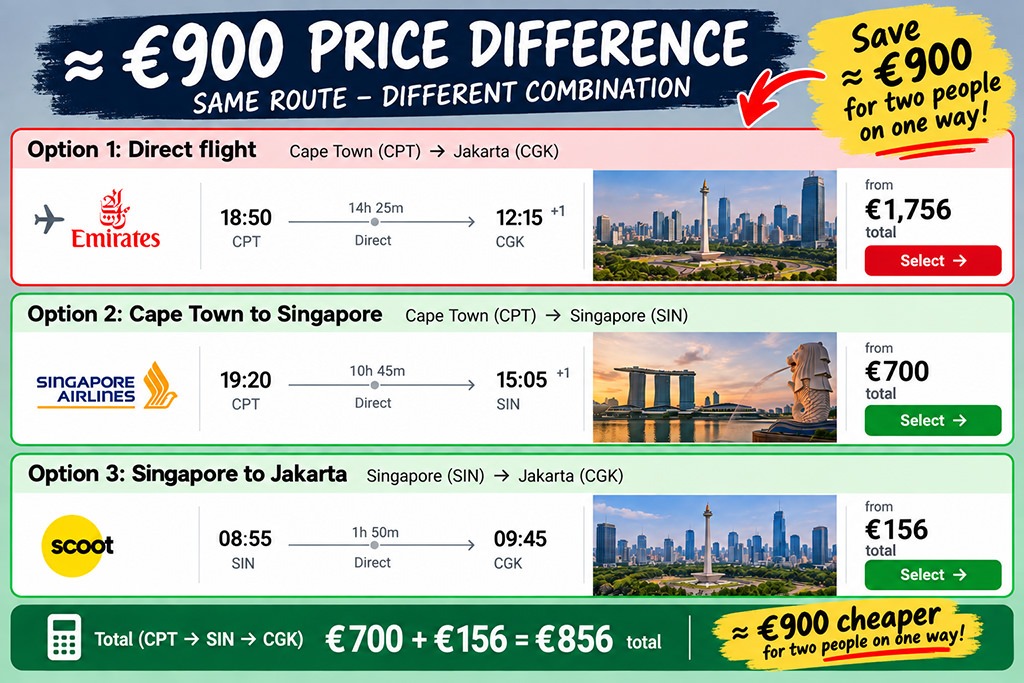
At the time we were planning, we were looking for a flight from Cape Town to Indonesia. So we tried all kinds of combinations: Cape Town via Thailand to Java, Cape Town via Thailand to Bali, Cape Town via Singapore to Java, Cape Town via Singapore to Bali and so on. After numerous searches and combinations, we discovered that flying via Singapore saved us around €900 for the two of us on a single one-way journey.
There was one more complication: at that point, we had no idea exactly when our vehicle would arrive in Montevideo. So we left the return flights open and initially booked only the outbound flights. Once we had a fixed date for the vehicle’s expected arrival in Montevideo, we repeated the same process for the return journey.
In total, this iterative approach saved us well over €1,200 on all flights alone.

The Costs Around the Shipping – Preparing the Vehicle and Ourselves
So, now we have the pure shipping costs and a rough idea of what our time without the vehicle was going to cost. But there was still another important part of the calculation: the costs before the vehicle even went into the container and everything we needed while it was on the ship.
After two years of travelling through Africa, our Sprinter had definitely seen better days. Thousands of kilometres, rough roads and especially a lot of rain had taken their toll. Since Patagonia was waiting for us on the other side, we decided not to simply fix the most urgent problems (as we would have done otherwise) but to give the vehicle a proper overhaul before shipping it.
That meant spare parts from Germany, materials from local hardware stores, tools, maintenance supplies and various smaller things we needed for the repairs. Some parts were ordered in Germany and shipped to South Africa, while others were bought locally or through Amazon and Takealot. Altogether, these vehicle preparation costs came to around €763.
Of course, the repairs also required somewhere to actually do the work. We didn’t want to spend a month repairing the vehicle somewhere in the bush, so we chose a campsite with an attached workshop and hardware stores nearby. That gave us roughly 30 days of accommodation and a proper place to work, which cost €349.94.
And even after all the repairs were finally finished, the vehicle still had one little problem: it didn’t fit into the container in its normal configuration. We therefore had to spend another US$200 on specially made container wheels so that we could get the Sprinter into the container.
We also needed two additional travel bags for the time without the vehicle. We will add those costs to the final calculation.
… And Then We Had to Get Ourselves to South America
With the vehicle prepared and handed over for shipping, the next part was our own journey. We first flew from Cape Town to Singapore (5 days stay), continued to Jakarta/Java, spent several weeks there, flew from Jakarta to Malaysia (Kuala Lumpur), stood here for another 11 days and eventually travelled back towards South America via Buenos Aires (9 days) to finally Montevideo (where we stood 6 days, before the Sprinter arrived).
This is where the costs start to become quite a mixture: flights, hotels, rental cars, visas, the ferry from Buenos Aires to Montevideo and eventually vehicle insurance for South America. We deliberately won’t break every single hotel night and every small purchase down here. The point is to show the big picture of what it actually cost us to bridge the 55 days without our vehicle.
All the travel-related expenses listed so far add up to roughly €5,060. Together with the approximately €763 for vehicle preparation, we are already at around €5,823 in additional costs.
And that is on top of the US$5,506 we had already paid for shipping and vehicle insurance, plus the US$200 for the container wheels.
This is exactly why looking only at the shipping quote can be misleading. The container itself is only one part of the equation. Once you add vehicle preparation, temporary accommodation, flights, rental cars, visas, additional luggage and all the logistics of getting yourselves to the other side, the real cost of the whole operation looks very different.
The Final Calculation – What Did It Really Cost?
So, after all the planning, calculating, repairing, flying, waiting and travelling, it is finally time to answer the question we started with:
What did it really cost to ship our vehicle from Africa to South America?
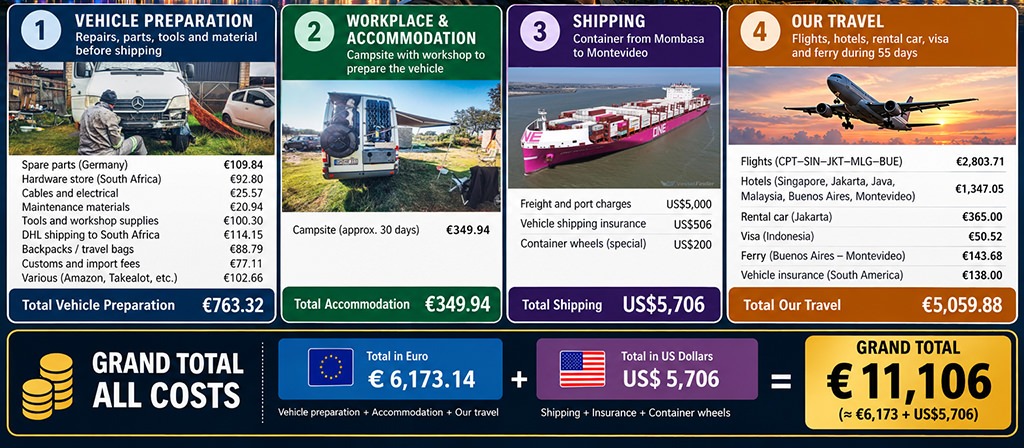
The easiest way to understand the final figure is to divide the whole operation into four parts:
Vehicle preparation: €763.32
Spare parts, tools, maintenance materials, shipping parts from Germany and everything else we bought specifically to prepare the Sprinter for the next stage of our journey.Campsite and workplace: €349.94
Around 30 days at a campsite where we had access to a workshop, hardware stores and a suitable place to get the vehicle ready.Our journey while the vehicle was at sea: €5,059.88
Flights, hotels, rental car, visa, ferry and the other major expenses required to get ourselves from Africa through Asia and eventually to South America.Shipping the vehicle: US$5,706
US$5,000 for the actual shipping including the relevant port charges and fees, US$506 for comprehensive vehicle insurance and another US$200 for the specially manufactured container wheels.
That leaves us with €6,173.14 plus US$5,706 for the entire operation, which makes approximately
€11,106 in total
And that is the number that puts the original shipping quote into perspective. On paper, shipping the vehicle cost us US$5,000. In reality, getting ourselves and our home on wheels from Africa to South America cost more than twice the amount you might initially associate with simply shipping a vehicle.
Of course, not everyone will end up with the same number. If you can stay at home while your vehicle is crossing the ocean, most of these additional expenses simply don’t exist. If, like us, you are travelling full-time and your vehicle is your home, the calculation looks very different.
So when comparing shipping quotes, don’t just ask How much does it cost to ship the vehicle?
The much more useful question is:
How much will it cost until both we and our vehicle are standing together on the other side of the ocean, ready to continue the journey?

A Last Note from the Authors
One last thing is worth mentioning: we really travelled on a very low budget during those two months – or at least we tried to. We stayed in very basic hotels, ate a lot of cheap food at food stalls, enjoyed very little luxury and avoided most expensive attractions and activities. For us, that was absolutely fine for a limited period, but it obviously came with some compromises.
Could we have travelled differently? Of course. We could, for example, have stayed in a very cheap apartment in Cape Town. But that would not necessarily have saved us money. Accommodation in Cape Town would still have cost us around €30 per night and more, whereas in the countries we travelled through, we were often paying well below €20 per night (mostly between 8€ and 12€). And then there is the question of getting around: even with a cheap apartment, we would still have needed a rental car. Attractions cost money, too, and food in Cape Town is considerably more expensive than along the route we actually travelled. Cape Town was not an option in any way.
So although our itinerary may look complicated and expensive – with several flights, hotels, rental cars and five countries – it was actually the cheapest option we came up with. We looked at different possibilities and, once we added up accommodation, transportation, food and everything else, this was the solution that made the most financial sense for us. In other words: it may look expensive on paper, but we really did not find a cheaper way of bridging those 55 days while continuing to travel independently. Crazy, isn’t it?
There was, of course, one option that would have been considerably cheaper: we could have moved in with our parents for those 55 days. That would have saved us a lot of money, but it was never an option for us. We wanted to continue travelling independently, and that is what these figures represent.
There is another important factor when comparing our numbers with your own plans: the shipping costs themselves can vary enormously. Our shipping was relatively expensive because the route we used is one of the more expensive shipping routes. On a cheaper route, the overall calculation could look very different.
And finally, the amount of time you have to bridge makes a huge difference. Two weeks without your vehicle is one thing. Two months is a completely different story. The longer you have to wait, the more you need to consider where you want to stay, what you want to do, what you want to see and simply how you want to live during that time.
So our €11,106 should not be seen as a universal price tag for shipping a vehicle overseas. It is what this particular solution cost us, under these particular circumstances. Much cheaper may be possible – but much more expensive certainly is.
Happy shippin’ 😊
Totti & Fenny
FAQ – Frequently Asked Questions
What exactly was included in the US$5,000 shipping price?
The US$5,000 covered the complete shipping operation for our vehicle in the shared container. This included:
- Ocean freight
- Container rental – split 50/50 with our container buddy
- Origin port fees
- Destination port fees
- Terminal Handling Charges (THC)
- Documentation and shipping paperwork
- Customs handling
- Container loading
- Container unloading
- Agent and handling fees
So the US$5,000 was much more than just the ocean freight itself. It covered the main costs involved in getting the vehicle into the container, transporting it overseas and getting it through the port process at the other end.
Not included were the separate comprehensive vehicle insurance of US$506 and the US$200 for the special wheels we needed to make the vehicle fit into the container.
Why did you choose a container instead of RoRo – and what would RoRo have cost?
For us, the main reason was security. With RoRo, vehicles are driven onto the ship and remain completely accessible to other people during the handling process. Break-ins and theft from vehicles are a well-known concern with RoRo shipping, and for us that was simply not worth the risk. Our Sprinter is not just a vehicle but our entire home and contains a lot of equipment and personal belongings.
A High Cube container, on the other hand, meant that our vehicle was locked inside the container for the entire ocean journey. We also shared the container with a container buddy, which made the container option considerably more affordable for us.
A Flat Rack would have been another possibility, but these are generally considerably more expensive than a container and therefore did not make financial sense for us.
As for RoRo pricing, we did not use it and therefore don’t have a reliable final price for our exact shipment. The price depends heavily on the route, vehicle dimensions and shipping line. In our case, the US$5,000 for the shared High Cube container was the figure we ultimately paid for the shipping operation.
Had you considered the additional costs beforehand?
Apparently not – at least not in enough detail. When we started looking into shipping options, our focus was mainly on getting the vehicle from A to B and finding a workable shipping solution. We did not initially think through all the costs that would arise from the fact that we would be without our vehicle for several weeks.
At one point, we were so desperate to find a solution that we were actually close to booking a shipment for almost €11,000: a container just for ourselves to Oman. Looking back, that would have been a very different calculation once all the additional costs had been added.
The problem was not that we completely forgot about accommodation, flights, rental cars, food and everything else. We simply didn’t calculate these costs in enough detail at the beginning. We were looking at the shipping price first and only gradually realised what it really meant to be without our vehicle for such a long period.
That is probably one of the biggest lessons we took away from the whole process: the shipping quote is only one part of the calculation. If you are travelling full-time and your vehicle is your home, you need to calculate what it will cost to live without it for the entire time it is at sea.
Why didn’t you just rent another camper in the meantime?
Hehehe… yeah, that was actually our very first idea. It sounded like the obvious solution: simply rent another camper and continue travelling while our own vehicle was on the ship.
Then we started looking at camper rental prices in Indonesia.
We quickly abandoned that idea when we saw that a basic camper alone would have cost us around €6,000 for the period. And that was before fuel, campsites, food and everything else.
So renting another camper would have completely changed the calculation. Instead of saving us money, it would have added another huge cost on top of the shipping. At that point, it became clear that we were better off travelling independently with a combination of cheap hotels, rental cars and flights.
How did you figure out which countries had the best climate?
We started by asking AI which countries would be good to travel through during those particular months, taking the climate into account. We had it put together an initial list of possible destinations.
We then used AI again as a starting point for our first round of research. It helped us narrow down the options and identify countries that were worth looking at in more detail. From there, we continued researching things like accommodation prices, rental cars, flights and general travel costs before making our final decision.
So AI was not the tool that made the final decision for us. It was essentially our first filter and research assistant, which helped us get from a blank sheet of paper to a manageable list of realistic options.
Why did you not fly directly to Uruguay and spend the time there?
Because Uruguay is ridiculously expensive for travelling on a budget. We looked at that option, but the costs quickly made it unattractive and Uruguay simply didn’t meet our climate requirements for that period of the year. So even though going directly to Uruguay would have been much simpler, it wasn’t really an attractive option for us from a money-, weather and climate perspective.
Rental cars are expensive, food is considerably more expensive than in the countries we eventually travelled through and even campsites can be surprisingly expensive. On top of that, campervans are difficult to find in Uruguay. When you do find one, they tend to be very expensive as well.
So although flying directly to Uruguay would have been much simpler, it would not have been the cheaper option. Once we compared the overall costs, travelling through several much cheaper countries while waiting for our vehicle turned out to make far more financial sense for us.
Looking back, would you do it the same way again?
Hmm… we’re honestly not sure. The trip itself was quite exhausting, mainly because of the many flights and all the moving around. It worked and it was the cheapest option we could come up with, but that doesn’t necessarily mean we would want to repeat the experience in exactly the same way.
Maybe we would do something similar again, but instead of moving through several countries, we would probably pick one country and stay there for most of the time. That would make the whole experience much less hectic and give us more time to actually settle in and enjoy the place.
More importantly, though, we would probably start planning much earlier and look for a shipping route with a shorter transit time. The route to Montevideo is generally one of the longer shipping routes worldwide, and having to bridge such a long period without our vehicle was ultimately what made this whole exercise so complicated and exhausting.
So yes, we might do something similar again – but fewer flights, fewer changes and, most importantly, a shorter shipping time.